Emergency Vehicle Decontamination: Safety
Hazard-assessment articles for emergency vehicle decontamination, including when bloodborne, chemical, respiratory, sharps, structural, or waste controls may apply. PPE and containment must follow the actual exposure—not a universal checklist.
Safety posts cover the hazards crews face while cleaning a unit, not just during the call itself. Articles talk about blood and body fluids hidden in cracks. They cover needles that slip under cot mattresses or into bench seams. They cover chemical exposure from mixing products or working in a closed space with no fresh air. They also cover strains from lifting stretchers and heavy gear bags. Other posts compare what crews can handle in-house with cases that call for an outside vendor. They explain why protective gear choices should follow a check of the hazards, not habit.
Get an email reply about emergency vehicle decontamination
Send a short message to the follow-up inbox. A coordinator can reply by email. This form does not send emergency help; call 911 first if anyone is in danger.
These topics matter because cleanup after a hard call often happens when crews are tired, rushed, or still thinking about the patient. That is just when a missed needle or a splash from a spray bottle is most likely. Clear steps help protect members who already carry a heavy load. So does keeping protective gear stocked in every bay. So does knowing anyone can pause the work when something feels unsafe. Posts also suggest simple habits that lower risk without slowing the work much. One example is sweeping for needles with a flashlight before anyone reaches into a seat seam.
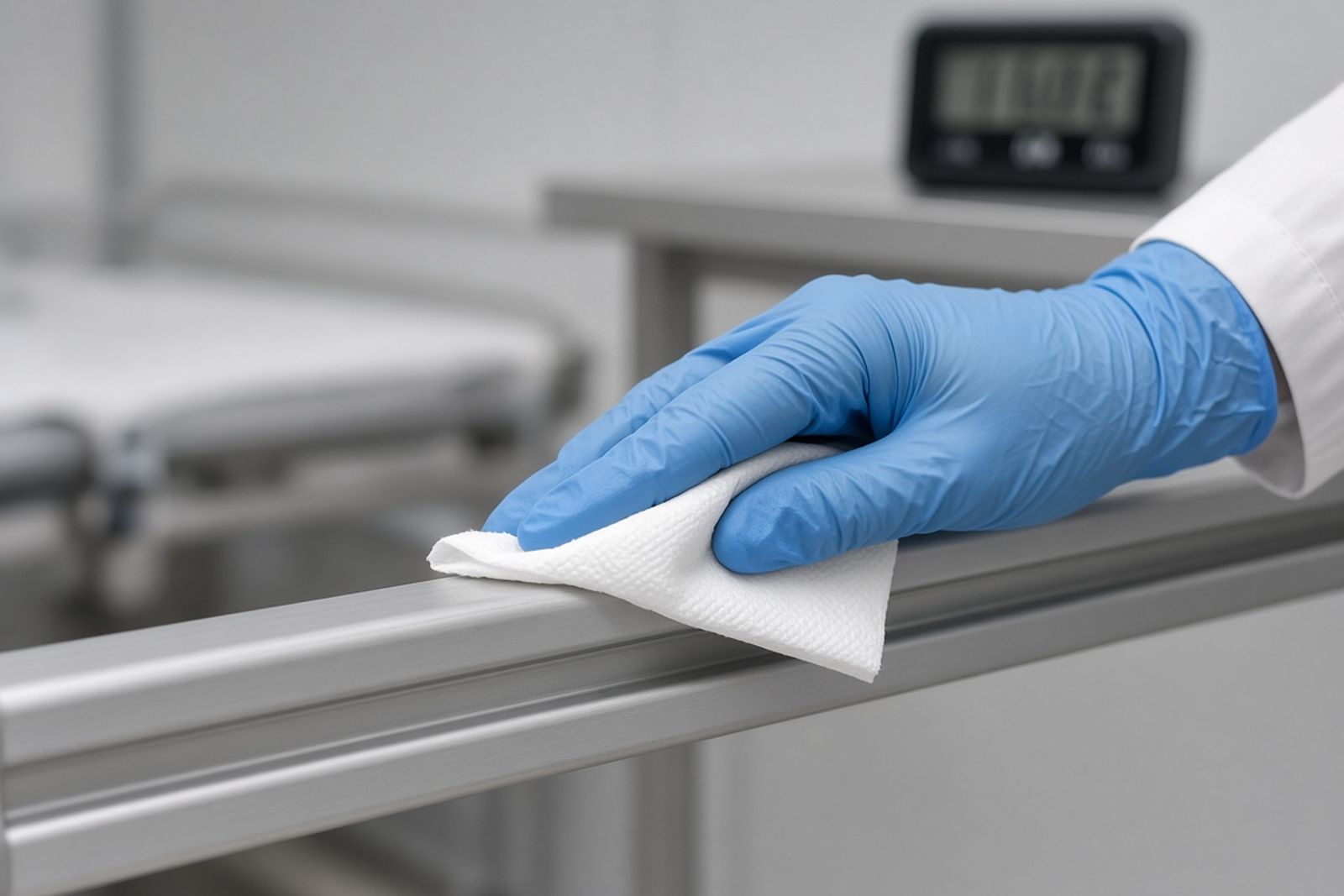
DIY vs Professional Emergency Vehicle Decontamination: The Critical Differences
When should crews handle ambulance or patrol-car decon in-house, and when should a unit go to an outside provider? Compare training, tools, and liability.
In-house crew decontamination works well for routine between-call cleaning and scheduled terminal cleans when staff are trained, supplied, and given enough time. Outside professional decontamination makes more sense after gross contamination, crashes, known high-risk organisms, or when audits show in-house cleans are falling short. The key differences are time, specialized products and tools, exposure risk to crews, documentation, and who removes and replaces damaged components.
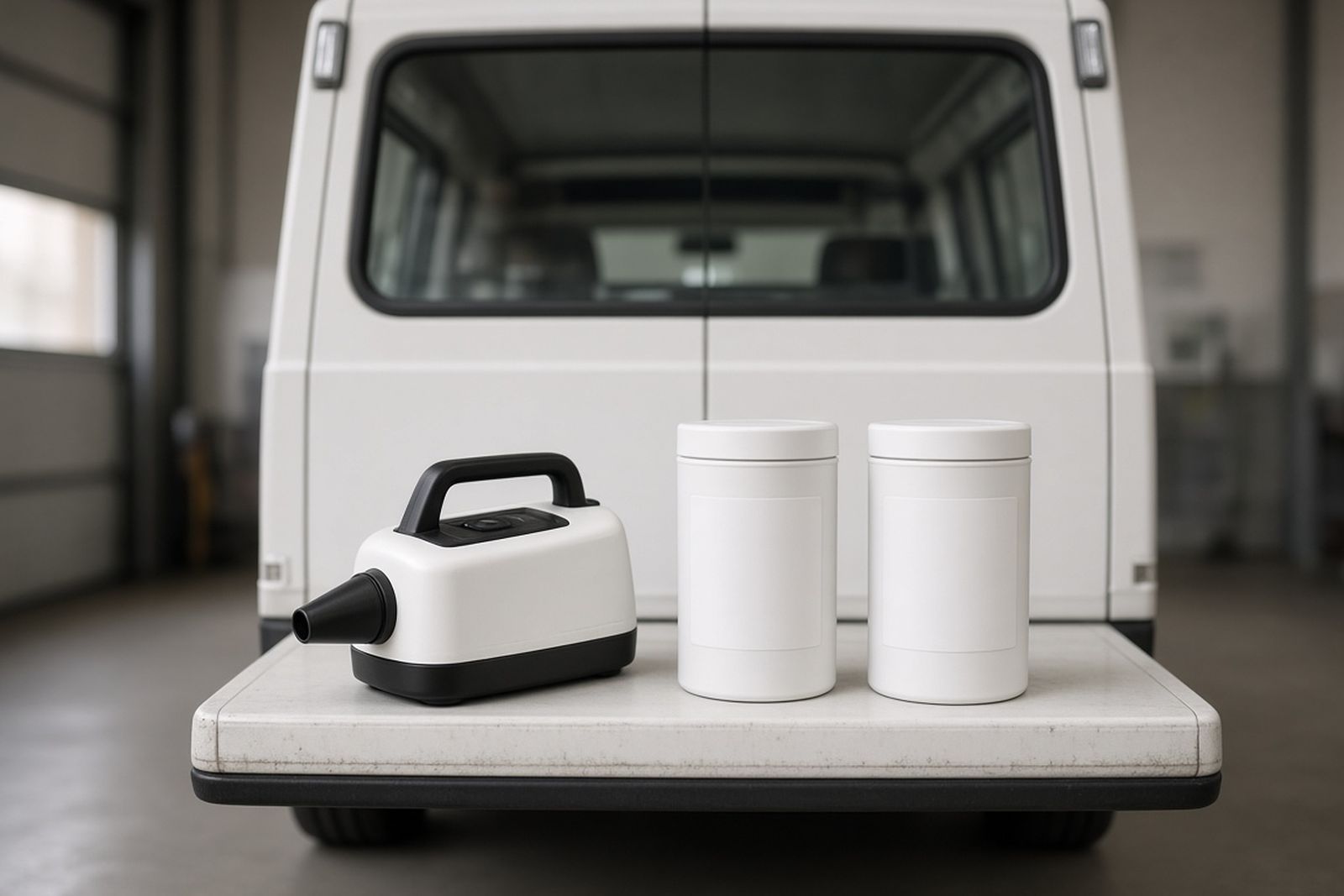
10 Emergency Vehicle Decontamination Safety Risks to Assess Before Work Begins
Hidden sharps, oxygen cylinders, chemical fumes, and crash damage can hurt the people cleaning a unit. Ten risks to check before any vehicle decon begins.
Before emergency vehicle decontamination begins, assess ten risks: body fluid exposure, hidden sharps, chemical inhalation, incompatible product mixing, airborne organisms in a closed compartment, oxygen and electrical hazards, vehicle movement in the bay, crash damage, physical strain and slips, and crew fatigue or distress. A short pre-work check, the right protective equipment, and a written procedure prevent most injuries.
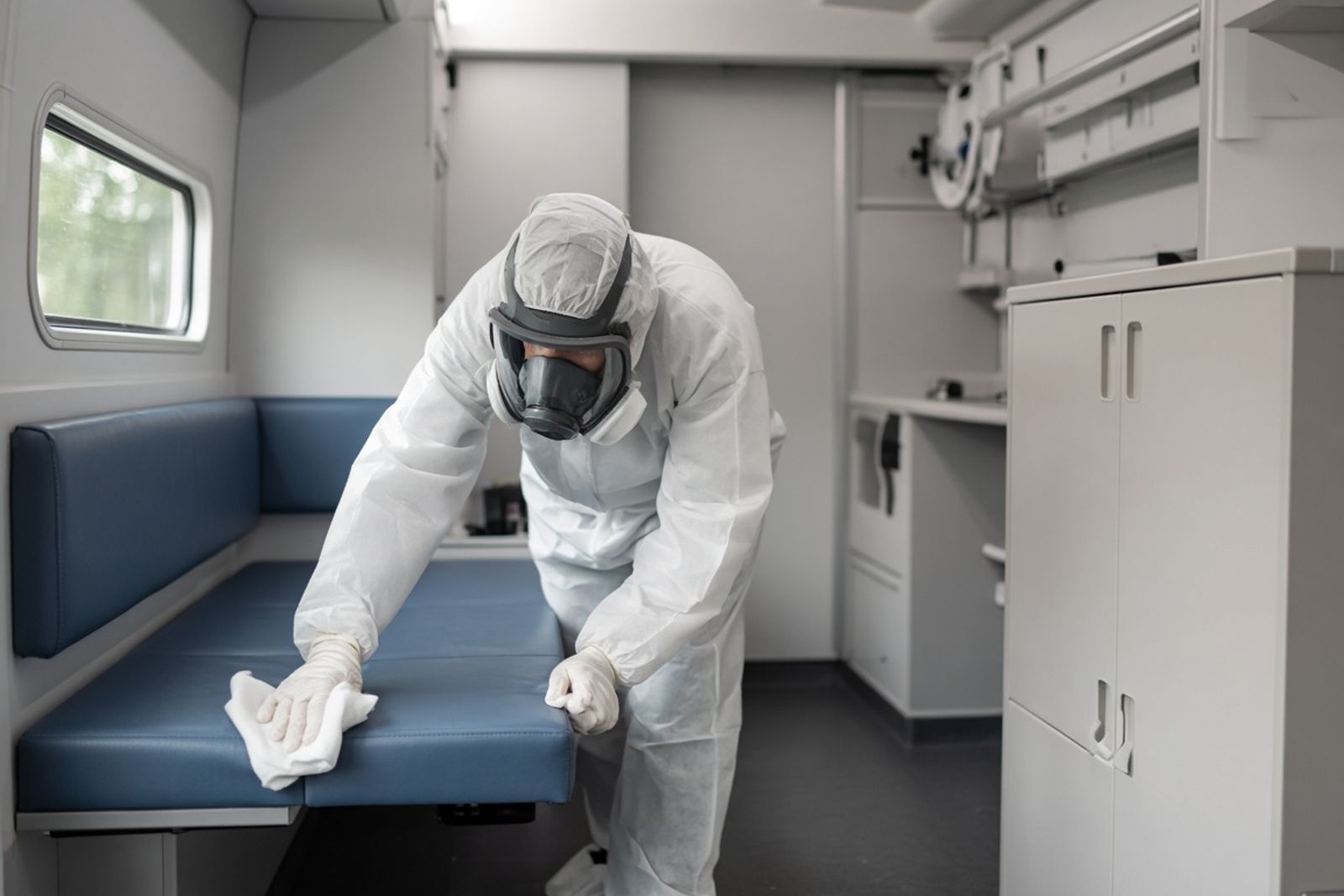
PPE Planning for Emergency Vehicle Decontamination: Start With the Hazard Assessment
Choosing gloves, gowns, eye protection, and respirators for ambulance and apparatus decon starts with a task-by-task hazard assessment, not a supply catalog.
PPE for emergency vehicle decon should come from a written hazard assessment of each task: between-call wipe-downs, terminal cleans, soft goods removal, sharps sweeps, and chemical mixing. Typical selections include chemical-compatible gloves, fluid-resistant gowns or coveralls, splash eye protection, and respirators when products or conditions require them. Train crews on donning and doffing, stock every size, and review the assessment when products or vehicles change.
Sourced figures on safety
- 19
An added hydrogen-peroxide wipe protocol left 19 of 48 sites tracer-positive.
Read with care: Surrogate-virus transfer, not measured patient infection; local workflow.
Source: Valdez et al. (2015)EMS field experiment using seeded bacteriophage as a microbial surrogate.
- 63.1%
63.1% of service-ready clinicians had at least one targeted pathogen detected.
Read with care: Detection of selected pathogens is not measured patient transmission.
Source: Schaps et al. (2026)20 ambulances and 27 clinicians from two US agencies; 941 samples, 2021–2022.
- 1.2 per 1,000 incidents
One EMS system logged 397 infectious-exposure reports, a rate of 1.2 exposures per 1,000 EMS incidents, with body-fluid splashes making up 14.1%.
Read with care: Single-agency data; exposure reporting practices vary widely.
Source: New Jersey Department of Health (research abstract compilation) (2015)Single U.S. EMS system exposure log
These figures are public research and agency data, not this network's own job records. Keep each number with its population, year and limits; none of them predicts cost, timing or outcome at a specific property.
What research has found
Findings from published studies of people and properties in situations like this one. They describe what researchers observed in a specific group; they are not predictions for your case.
Observed transfer patterns implicated responders' hands.
Only four samples were classified as containing pathogens.
Safety: common questions
What protective gear should crews wear while cleaning a dirty unit?
Common starting points are gloves that suit the disinfectant, eye protection, and a fluid-proof gown or apron. Add more protection when you expect splashing or steps that spray fine droplets into the air. The right mix depends on the mess and the products used. So follow your exposure control plan and the disinfectant's safety data sheet.
How should crews handle sharps found during vehicle cleaning?
Stop. Use tongs or another tool, not your hands, to pick up the item. Then put it right into a sharps container. Never reach blindly under mattresses or into seams. If someone is stuck or splashed, follow your agency's exposure steps right away. Report it to the infection control officer.
Is it safe to clean a unit with the doors closed?
Closing up the patient area traps fumes from disinfectants. This can make crews lightheaded or bother their eyes and airways. Open the doors, run the fans as advised, and do not mix products. Check the safety data sheet for airflow advice. Move the vehicle to a bay with better airflow if the space feels stuffy.
How should crews protect their eyes when cleaning overhead surfaces?
Wear goggles or a face shield over safety glasses when you wipe ceilings, upper cabinets, or grab rails. Liquid runs down toward your face. Use a tool on a pole when you can, so you are not working right under the surface. Everyday prescription glasses do not protect against splashes. Keep eye protection in each cleaning kit so crews do not have to go looking for it.
What should crews do if a disinfectant gets on their skin?
Follow the first aid directions on the product label and safety data sheet. They usually say to rinse with lots of water. Take off any clothing with product on it. Report the exposure to a supervisor. Get medical care if the irritation does not go away or if the product was strong and not diluted. Afterward, check whether the gloves or gowns were right for that product and task.
How can we prevent back injuries during decon?
Get help lifting stretchers, cushions, and heavy waste bags. Use carts or dollies when you can. Do not twist while reaching into cabinets or under benches. Use a step instead of jumping out of the unit. Plan deep cleans so crews are not doing heavy physical work at the end of a draining shift. Report strains early.
Is it safe to clean a unit while the engine is running?
It is best avoided. Engine exhaust in an enclosed bay can build up quickly, and moving parts and heat add hazards. Use shore power, open doors, and bay ventilation instead. If the engine must run, connect the exhaust capture system, keep bay doors open, and keep people away from the tailpipe.
Related community polls
Every count is a real visitor vote; nothing is seeded or padded. One vote per poll per device, and you can change your answer.
After a bloody transport, what usually decides whether your unit gets a full deep clean?
Who performs terminal cleans on your fleet most of the time?
More on emergency vehicle decontamination
Emergency Vehicle Decontamination services
Learn how deep cleans of ambulances, fire trucks, and police cars are planned. See needle sweeps, choices about soft items, and records by unit number.
Costs explained
What drives the price, published cost ranges, and how to read a written quote line by line.
Insurance and payment
Which policies may respond, how to document a claim, and what to do if coverage is denied.
Planning tools
Guided planners for fleet managers. Get cost ranges, vendor checks, insurance steps, first-day actions, waste sorting, and in-house versus vendor risk.
Community polls
See how other EMS, fire, and police fleets handle time pressure, new soft items, records, and product choices in their own bays.
Knowledge quiz
Test what you know about cabin hazards, who pulls a unit from service, containment, contact time, waste, and cleaning records before the next hard call.