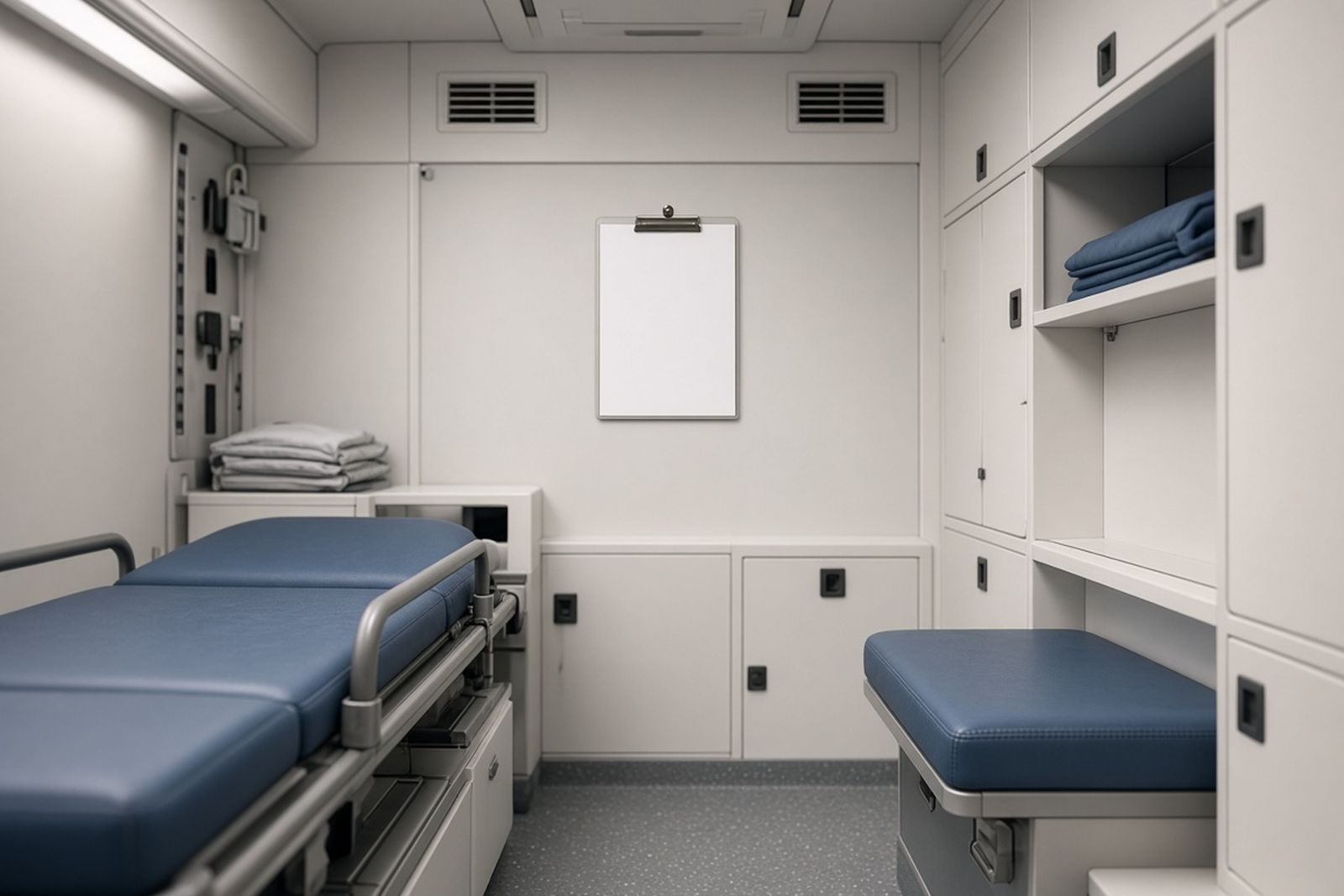
Knowledge check with explanations

Emergency Vehicle Decontamination quiz and study guide

Find out what you already understand, then read the parts you missed.

This quiz checks what fleet managers, station officers, and infection-control leads need to know. It is for the moment a unit comes back from a bloody or infectious call. It is not a certificate. It does not replace your agency's infection-control plan or your required bloodborne disease training under 29 CFR 1910.1030. It checks whether you can spot what makes a vehicle interior unsafe. It asks who decides when a unit goes out of service and when it comes back. It covers how to keep germs from spreading in a small space and why disinfectant fails on a dirty surface. It also covers where dirty soft items and needles go, and what a solid cleaning record holds. The questions you miss are the useful ones, so read the explanations.

Get an email reply about emergency vehicle decontamination

Send a short message to the follow-up inbox. A coordinator can reply by email. This form does not send emergency help; call 911 first if anyone is in danger.

Tell us what you need help with. Share a short description; please leave out medical details, access codes, and other sensitive information.

A request does not confirm a booking. For immediate danger, contact local emergency services.

Or email info@prompartybuses.com

The study guide below covers the same six ideas the quiz uses. Read it first if you like to learn before testing. Or read it after to fill the gaps the quiz showed. Share the quiz with crew members who do between-call wipes. Share it with the supervisors who clear units to return, too. When all ranks use the same words, there are fewer arguments at the bay door. It also helps when a vendor is involved. A supervisor who understands contact time and how to judge soft items can hold the contractor to the agency's standard. Take the quiz again when your product list or infection-control plan changes.

Emergency Vehicle Decontamination knowledge check

15 questions about real emergency vehicle decontamination situations: staying safe, what happens, cost, choosing help and the rules. Every answer comes with a short explanation.

Why this quiz matters

Knowing these basics makes it easier to spot bad advice and ask a company the right questions. This quiz is educational — it does not certify anyone. After the quiz, review the explanations for questions you missed. For professional guidance on your specific situation, use the contact form at the top of the page for an email reply.

Progress1 / 15
ProcessQ1

An ambulance comes back from a call with blood on the floor and stretcher. What should happen to the unit first?

Study guide: the six ideas behind the questions

Read these before or after the quiz. They cover the concepts every question draws on, written for emergency vehicle decontamination specifically.

1Recognizing hazards inside a vehicle interior

A patient area or the back seat of a patrol car packs many hazards into a small, closed space. Blood and other body fluids that can carry disease may be easy to see on the floor. They may also hide under mats, in bench seams, inside cabinet edges, on belt straps, and in foam under a torn mattress cover. Needles may be loose under seats after a chaotic call. Tiny droplets from suction or a coughing patient can settle on vents and controls. In fire trucks, smoke residue on cab surfaces adds a chemical layer. Germs follow hands, gravity, and airflow. They do not stay where the patient was. Knowing this is the base of a deep clean that truly protects the next crew.

2Who controls the unit and its status

The agency owns the choice about whether a unit is in service. The crew does not, and the vendor does not. That authority should be written into the infection-control plan. The plan should say which events call for an out-of-service deep clean and who tags the unit. It should say who can override for coverage reasons, and when. It should also name who signs to return the unit to service. Police vehicles add evidence concerns. When a rear seat area may hold evidence, the rules for handling evidence come before cleaning. The supervising officer decides when cleanup may start. Clear authority prevents a common failure. That is when a visibly dirty unit is pushed back into service because nobody felt free to say no.

3Containment in a confined compartment

Containment in a vehicle means keeping germs from spreading. You want to keep them out of the cab, the station bay, other units, and the crew's gear. Tag the unit and park it where waste can be staged. Pick a spot where other crews will not walk through the work area. Remove medical supplies and personal items as the agency directs before cleaning starts. Bag dirty disposables and linens right where you remove them. Do not carry them across the bay. Keep the cab door closed if only the patient area was affected. Do not use compressed air or dry sweeping. These push debris into vents and seams. If you use odor or mist treatments, make sure the unit and bay are empty and aired out as the product label says.

4Cleaning first, then disinfection

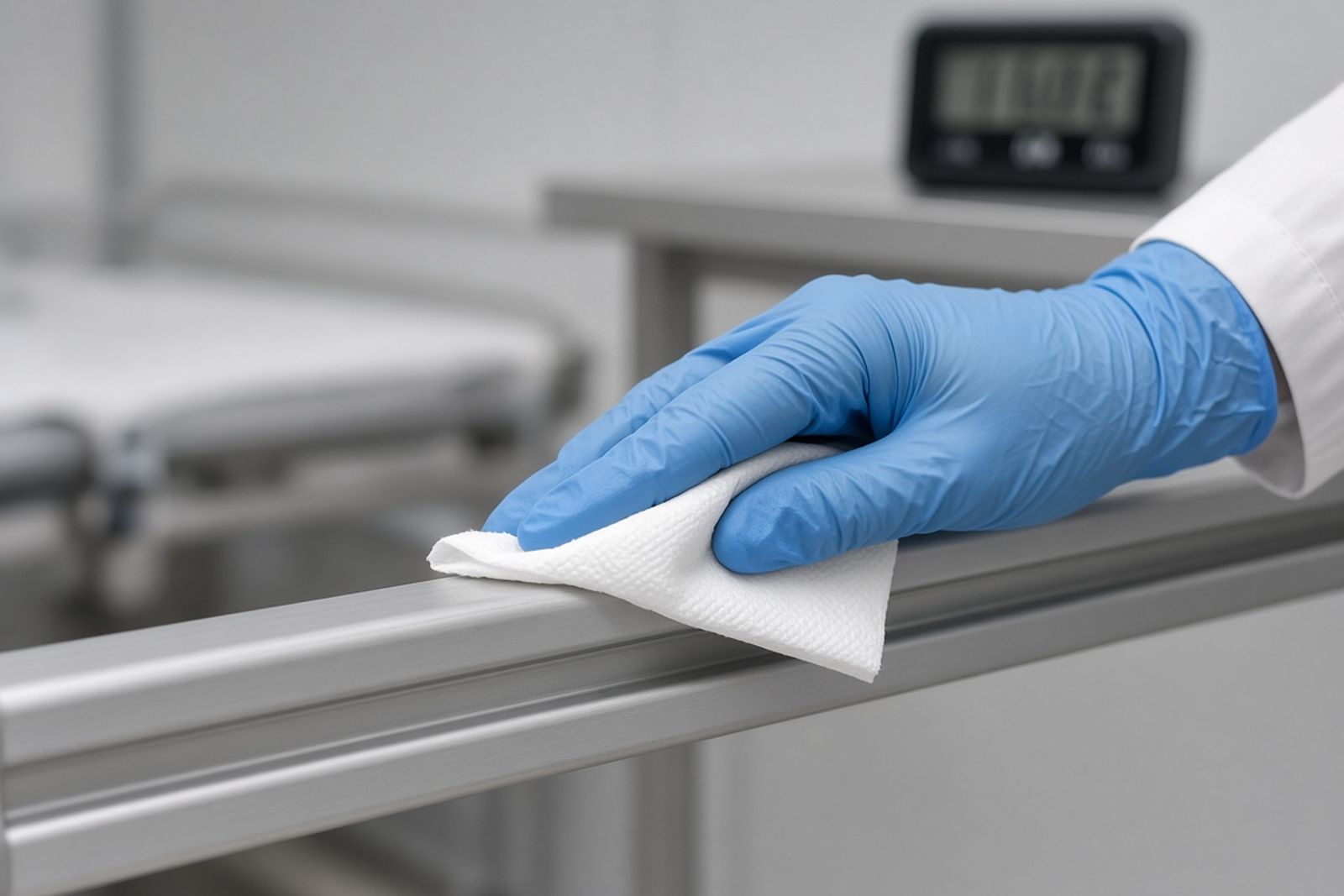
Disinfectants are tested on clean surfaces. If you spray them over blood, mud, or body fluid, the dirt soaks them up. They never reach the surface below, so the label claim does not apply. That is why a deep clean starts with removing heavy dirt. Use soap and throwaway materials for this step. Then disinfect with a registered product and keep it wet for its full contact time. Contact time is how long the disinfectant must stay wet on the surface. A wipe that dries in seconds does not meet it. On soft items, cleaning only reaches the surface. That is why soaked foam gets replaced. On electronics and screens, the product and method must match the maker's guidance. If not, the cleaning can break equipment.

5The waste path from the bay

Some waste usually goes in the regulated medical waste stream. This includes bloody disposables, dirty linens that will not be washed, soaked foam, and used absorbents. It goes in labeled containers and is picked up by a licensed hauler. Needles found during the sweep go in puncture-proof containers, never in bags. Do not pour suction canister contents or other collected liquids down a bay floor drain until you confirm local sewer rules. Reusable linens go to a laundry that handles dirty fabrics. Packaging, clean disposables, and barrier materials that never touched fluids are regular trash. Rules vary by state and county. So check the right path for each type of waste with the local authority. Keep hauler receipts with the unit's cleaning record.

6Recording the cycle so it can be audited

A cleaning record is the only proof that a deep clean happened and how it was done. It should list the unit number, the call that led to it, and the times the unit left and returned to service. It should name the products and contact times used. It should list each soft item and whether it was cleaned or replaced. Add any test, such as a swab reading on a set of high-touch spots. Include the worker or crew name and the supervisor who cleared the unit. Photos of replaced items help with both buying and the infection-control file. Records kept by unit show patterns. An ambulance that keeps needing new mattresses may have a design problem. A station with thin records may have a training problem. Audits, exposure reviews, and complaints all reach for the same file.
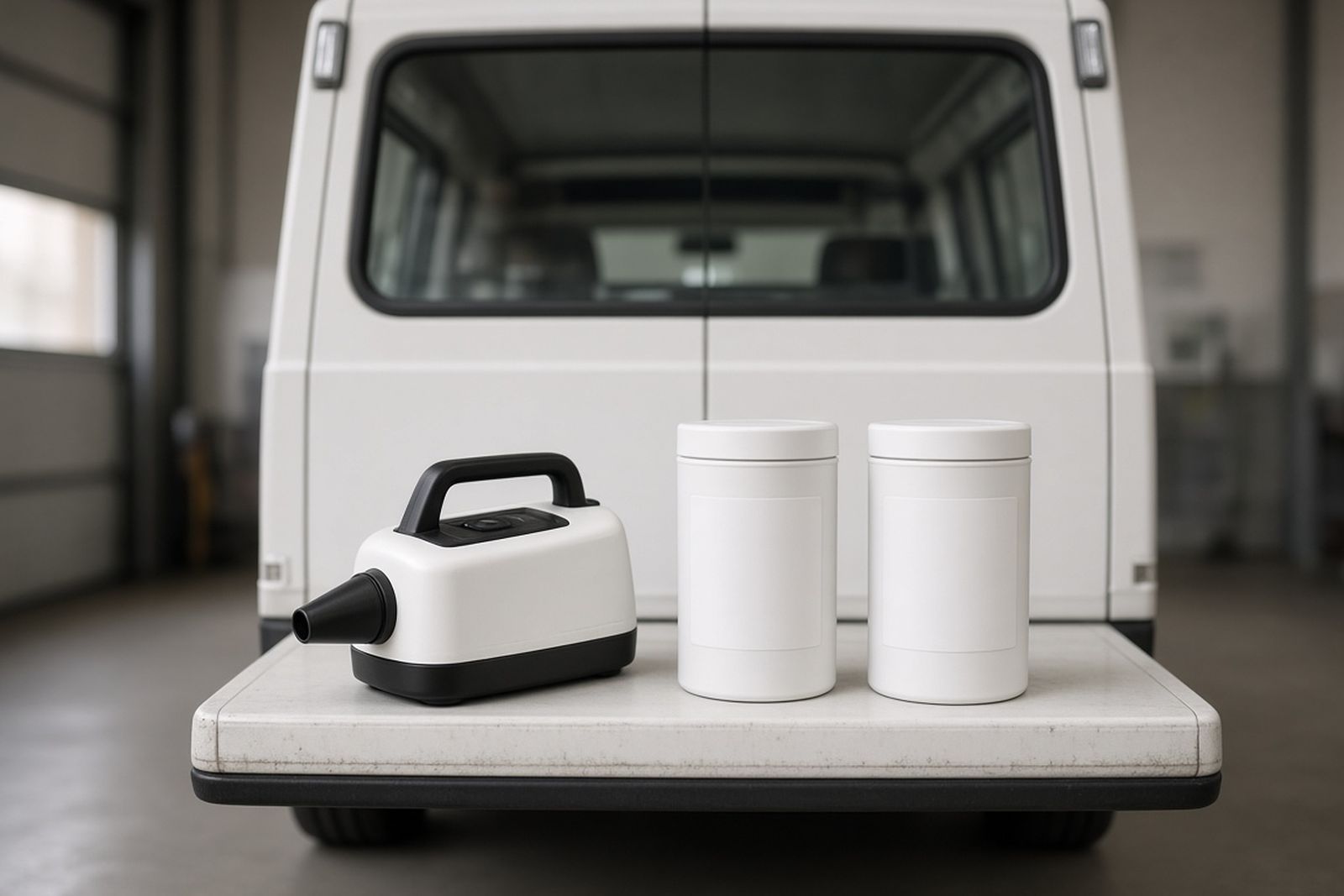
Handheld fogger and two wipe canisters on the rear step of a white ambulance in a garage bay
Illustrative photo, not a job record. Handheld fogger and two wipe canisters on the rear step of a white ambulance in a garage bay.

Emergency Vehicle Decontamination facts the quiz draws on

55%

Reported disinfection compliance was 55% for stretchers and only 4.1% to 47% for stethoscopes in EMS studies reviewed.

Read with care: Ranges pool heterogeneous study designs and countries.

Source: Antimicrobial Resistance & Infection Control (PMC) (2025)16 studies (8 USA), published 2010-2024

63.1%

63.1% of service-ready clinicians had at least one targeted pathogen detected.

Read with care: Detection of selected pathogens is not measured patient transmission.

Source: Schaps et al. (2026)20 ambulances and 27 clinicians from two US agencies; 941 samples, 2021–2022.

27

Tracer spread from seeded surfaces to 27 of 48 other sampled sites.

Read with care: Surrogate-virus transfer, not measured patient infection; local workflow.

Source: Valdez et al. (2015)EMS field experiment using seeded bacteriophage as a microbial surrogate.

8.6 per 100 FTE

Career EMS workers sustained ED-treated injuries at a rate of 8.6 per 100 full-time equivalent workers, based on NIOSH's national follow-back survey.

Read with care: Confidence interval 5.3-11.8; excludes volunteers.

Source: NIOSH / Prehospital Emergency Care (2017)United States, career EMS workers, 2010-2014

These figures are public research and agency data, not this network's own job records. Keep each number with its population, year and limits; none of them predicts cost, timing or outcome at a specific property.

Questions about the emergency vehicle decontamination quiz

Is this quiz useful for line crews or only for supervisors?

Crews benefit at least as much. They perform between-call wipes, notice soiled soft goods first, and are the ones exposed when a unit is not properly cleaned. The questions are plain-language and explain terms like contact time on first use. A crew that understands why the standard exists is more likely to flag a unit that needs a terminal clean.

Does passing the quiz mean our station can skip a vendor?

The quiz measures what you understand, not what your agency can do. Whether your agency does deep cleans itself depends on several things. These include your infection-control plan, the products and containers you have, your waste setup, and your staffing. It also depends on whether soaked soft items or unusual hazards are involved. The site's DIY or Call a Pro risk check covers that choice. Review it with your infection-control lead.

Why does the quiz emphasize contact time so heavily?

Because it is the most common shortcut. A surface that is wiped and dries in moments has not really been disinfected, no matter what product was used. Pressure to get the unit back fast makes this shortcut tempting. The quiz aims to help everyone in the chain, from crew to supervisor, understand what the label truly requires.

Does the quiz cover police cars and fire trucks?

Yes. One question covers a patrol car back seat after an in-custody death, where investigators must release the vehicle before cleanup starts. Another covers a fire truck cab, where body fluids and smoke residue may sit on the same seats, handholds, and controls. When an idea mainly applies to ambulances, such as stretcher mattresses, the explanation says so and notes the matching concern in patrol cars and fire truck seats.

Can we use the quiz in our annual training?

Use it to spark talk at shift briefings or in supervisor training. But do not claim it meets a specific required training rule. Those rules set their own content and record-keeping. Pair the quiz with your written plan. Let your infection-control officer decide how it fits next to formal bloodborne disease training.

What if our agency does things differently from a quiz explanation?

Look into the difference instead of assuming either one is wrong. The explanations describe general practice and cite rules where they apply. But your agency may follow a stricter standard, a state health rule, or a maker's guidance for certain equipment. Compare with your written plan and ask your infection-control lead. Write down what you find so the reasoning is kept.

How often should crews and supervisors go over this material again?

Go over it whenever the product list, unit design, or infection-control plan changes. Also review it after any exposure or near miss that involved a vehicle. Many agencies also go over cleaning basics when new members join a station. Taking the quiz again at those times is a quick way to check that shared knowledge has not slipped under daily call pressure.

What other visitors think

Poll results

Every count is a real visitor vote; nothing is seeded or padded. One vote per poll per device, and you can change your answer.

Process

After a bloody transport, what usually decides whether your unit gets a full deep clean?

No visitor votes yet
Industry

Who performs terminal cleans on your fleet most of the time?

No visitor votes yet