Decon Services for Ambulance, Fire, and Police Units
The services below cover one-time cleanups and ongoing fleet programs for response vehicles. Each entry names the units it suits, the steps involved, and the records your agency should get.
Get an email reply about emergency vehicle decontamination
Send a short message to the follow-up inbox. A coordinator can reply by email. This form does not send emergency help; call 911 first if anyone is in danger.
Picking the right service for your fleet
Ambulances, fire trucks, and patrol cars are built differently, and each has its own trouble spots. The service you choose should match the vehicle and the kind of exposure. One agency may use all four, from a single messy call to a year-round program.
Every service here should follow your agency's infection control policy and the product labels. The crew does the cleaning, but your supervisor decides when a unit returns to service. Make sure the provider's paperwork fits your records system.
The services, one by one
Ambulance Decontamination
Who it is for: EMS agencies and private ambulance companies with a unit that carried a patient with heavy bleeding, vomiting, or a known infection.
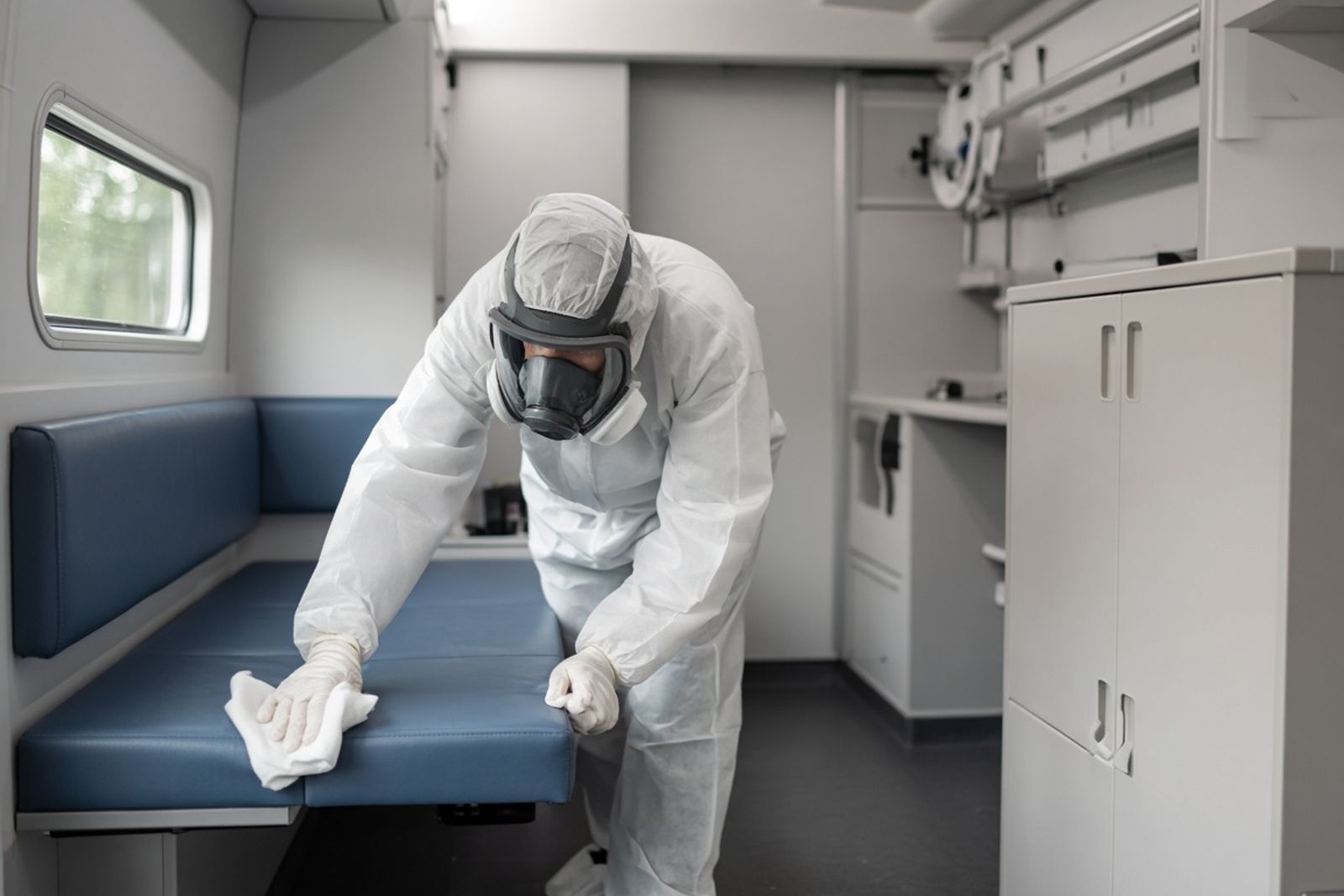
The unit is stripped of equipment and soft goods. The crew removes visible fluids, then cleans and disinfects every surface, including the stretcher frame, rails, cabinets, and seat belts. Mattresses and straps with tears are set aside for replacement. Waste and sharps are packed for pickup.
What you should get: A decon log with the unit number, times, products, and a list of replaced items.
Fire Apparatus Cleaning
Who it is for: Fire departments whose engines, ladders, or rescues carried a patient, assisted on an EMS call, or picked up fluids on a response.
The crew checks the cab, jump seats, compartments, and handholds for soil. Seats, belts, and controls are cleaned, then disinfected with products that suit the materials. Outside surfaces of SCBA packs and shared tools are cleaned under department rules. Cab air filters may be changed if fluids reached the vents.
What you should get: Out-of-service and return times and a list of areas cleaned for the department file.
Police Vehicle Biohazard Cleaning
Who it is for: Police departments and sheriff's offices with patrol cars or transport vans soiled by blood, spit, vomit, or other fluids.
If the vehicle holds evidence, the crew waits for investigators to release it. They clean the rear seat, partition, floor, and door panels, then disinfect them. Foam seats that soaked through are replaced. Any needles or other sharps found are placed in a hard container.
What you should get: A cleaning record that fits your fleet and risk management files.
Fleet Decontamination Programs
Who it is for: Agencies with many units that want the same process and records at every station, on a set schedule or on call.
The provider and your infection control lead agree on what triggers a full clean versus a quick wipe. Product lists and replacement rules are set for the whole fleet. Each visit is logged by unit number and time. The schedule is adjusted based on call volume and exposure history.
What you should get: Consistent logs across units and periodic summaries you can use for audits and budgeting.
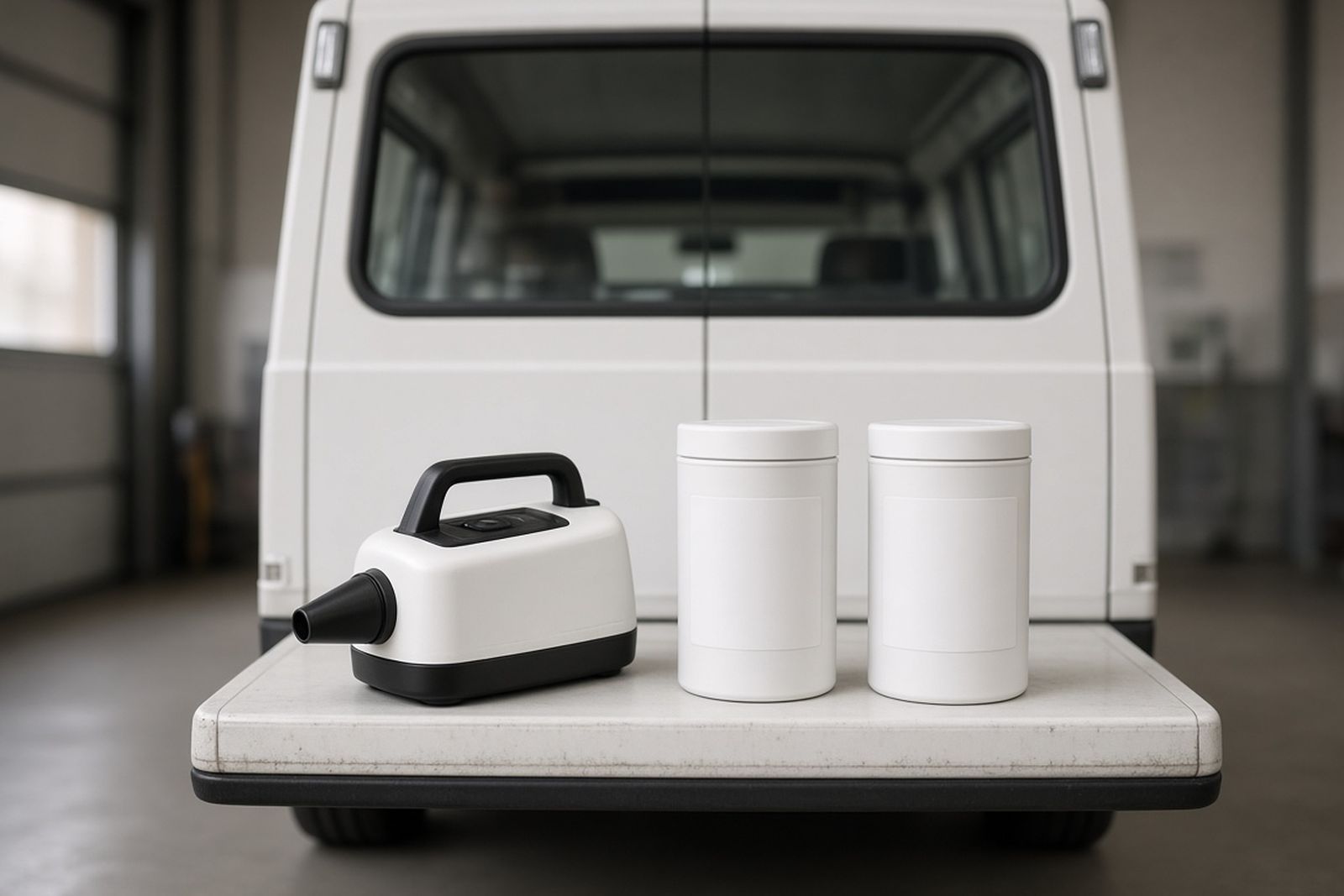
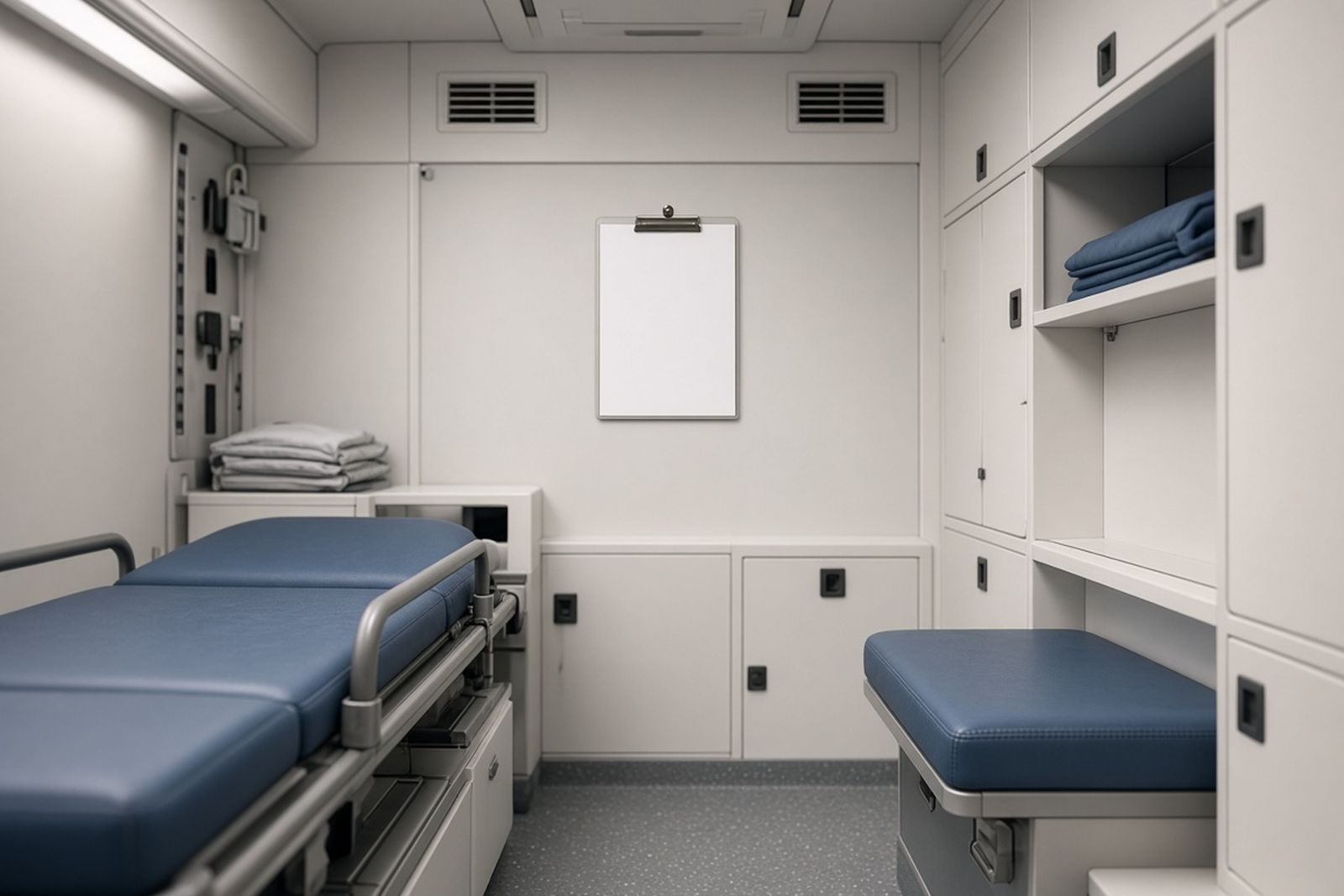
Illustrative photo, not a job record. Handheld fogger and two wipe canisters on the rear step of a white ambulance in a garage bay.Illustrative photo, not a job record. Clean, restocked ambulance compartment with a blank log card clipped to the wall.
Emergency Vehicle Decontamination in numbers
52%
The reported contamination rate fell from 52% before disinfection to 8% afterwards.
Read with care: Abstract does not provide sample count; product-specific; contamination is not infection.
Source: Farhadloo et al. (2018)Ambulance cabins and equipment in Qom, Iran, treated with one named disinfectant.
4
Critical-equipment samples were culture-positive in 4 of 26 instances.
Read with care: Detection is not infection; small local fleet; most isolates were environmental flora.
Source: Noh et al. (2011)13 Seoul ambulances; 33 sites each, 429 samples.
26
Existing decontamination left 26 of 48 sites tracer-positive.
Read with care: Surrogate-virus transfer, not measured patient infection; local workflow.
Source: Valdez et al. (2015)EMS field experiment using seeded bacteriophage as a microbial surrogate.
60%
60% of ambulances labelled service-ready had at least one targeted pathogen.
Read with care: Detection of selected pathogens is not measured patient transmission.
Source: Schaps et al. (2026)20 ambulances and 27 clinicians from two US agencies; 941 samples, 2021–2022.
These figures are public research and agency data, not this network's own job records. Keep each number with its population, year and limits; none of them predicts cost, timing or outcome at a specific property.
What vehicle decon does not include
Cleaning turnout gear. That follows the gear maker's guidance and is done by a gear cleaning service or trained station staff.
Medical follow-up for crew exposures. Your infection control officer and occupational health provider handle that.
Repairs to stretchers, lifts, or monitors. The equipment maker's service tech does that.
Mechanical or body repair after a crash. Your fleet shop or a body shop handles it.
Evidence collection. Investigators and crime scene staff handle it before cleanup begins.
Once the unit is back in service
Ask the next crew to report any odor, residue, or sticky surfaces during their first shift in the unit. File the decon log with the run or case number. Order replacement straps, covers, and mattresses early so the unit is not held up waiting for parts.
Hard calls stay with people. Check on crews who were on the call, and remind them of peer support or employee assistance programs. Anyone thinking about harming themselves can reach the 988 Suicide and Crisis Lifeline.
Findings from published studies of people and properties in situations like this one. They describe what researchers observed in a specific group; they are not predictions for your case.
All sampled equipment categories showed significantly lower contamination after treatment.
Every count is a real visitor vote; nothing is seeded or padded. One vote per poll per device, and you can change your answer.
Process
After a bloody transport, what usually decides whether your unit gets a full deep clean?
No visitor votes yet
Industry
Who performs terminal cleans on your fleet most of the time?
No visitor votes yet
Safety
How do you decide whether a stretcher mattress or seat cushion is replaced rather than cleaned?
No visitor votes yet
Before you hire: emergency vehicle decontamination questions
Can the provider come to our stations?▼
Many providers can work at your station if there is a bay with room to open all doors, good lighting, and a spot for waste. Working on site cuts downtime and keeps a soiled unit off the road. Ask what they need from you, such as water, power, and bay time. Some work is better done at a shop, like seat replacement.
What if fluids reached the air vents?▼
Vents near the patient area can pull in droplets, especially during airway care. The crew can clean vent covers and nearby ducts they can reach. Cabin air filters are usually replaced. Deeper parts of the system may need the vehicle maker's guidance or a fleet shop. Ask the provider to note on the log what they did with the vents.
How are K-9 units handled?▼
K-9 units have kennels, mats, and fans that trap hair and fluids. Crews clean and disinfect these areas with products that are safe for dogs once they have dried. The dog should stay out of the vehicle until the label's wait time has passed and the space has aired out. Tell the provider about the kennel setup before the visit.
What happens to a stretcher that is damaged during cleaning?▼
If the crew finds a torn mattress, cracked parts, or a broken latch, they should stop and tell you. Repairs belong to the stretcher maker's service tech or your own equipment staff. The crew can clean around the damage, but it should be flagged on the log. Do not return a stretcher to service with torn covers that let fluid in.
Can a fleet program include training for our crews?▼
Some providers offer short sessions on topics like when to call for a full clean, how to bag waste, and how to keep the cab clean. Training should match your infection control policy, not replace it. Ask for the training outline in writing. It helps if the provider's crew and your staff use the same terms and logs.
What about a unit involved in an in-custody death?▼
Investigators control the vehicle until they release it, and the cleanup must wait. The provider should be told that the case is under investigation. Once released, the cleaning steps are similar, but officers may find it hard to see the unit. Some agencies move the vehicle to a separate lot and offer peer support to those involved.
Can we mix outside decon with our own crews' cleaning?▼
Yes, and many agencies do. Your crews may handle routine wipes and light terminal cleans, while the provider takes heavy events. The key is a clear written line between the two, shared products, and one log format. That way, anyone reading the records sees the full history of each unit.