Short answer
Commercial emergency vehicle decontamination covers agency-owned ambulances, engines, and patrol cars, where an employer program, approved products, and waste contracts already exist. The residential side covers personal vehicles, gear bags, and uniforms that volunteer or off-duty responders bring home, where none of that infrastructure exists. The biology is the same, but responsibility, tools, waste options, and family exposure are very different, so plan for both.
Two settings, same biology
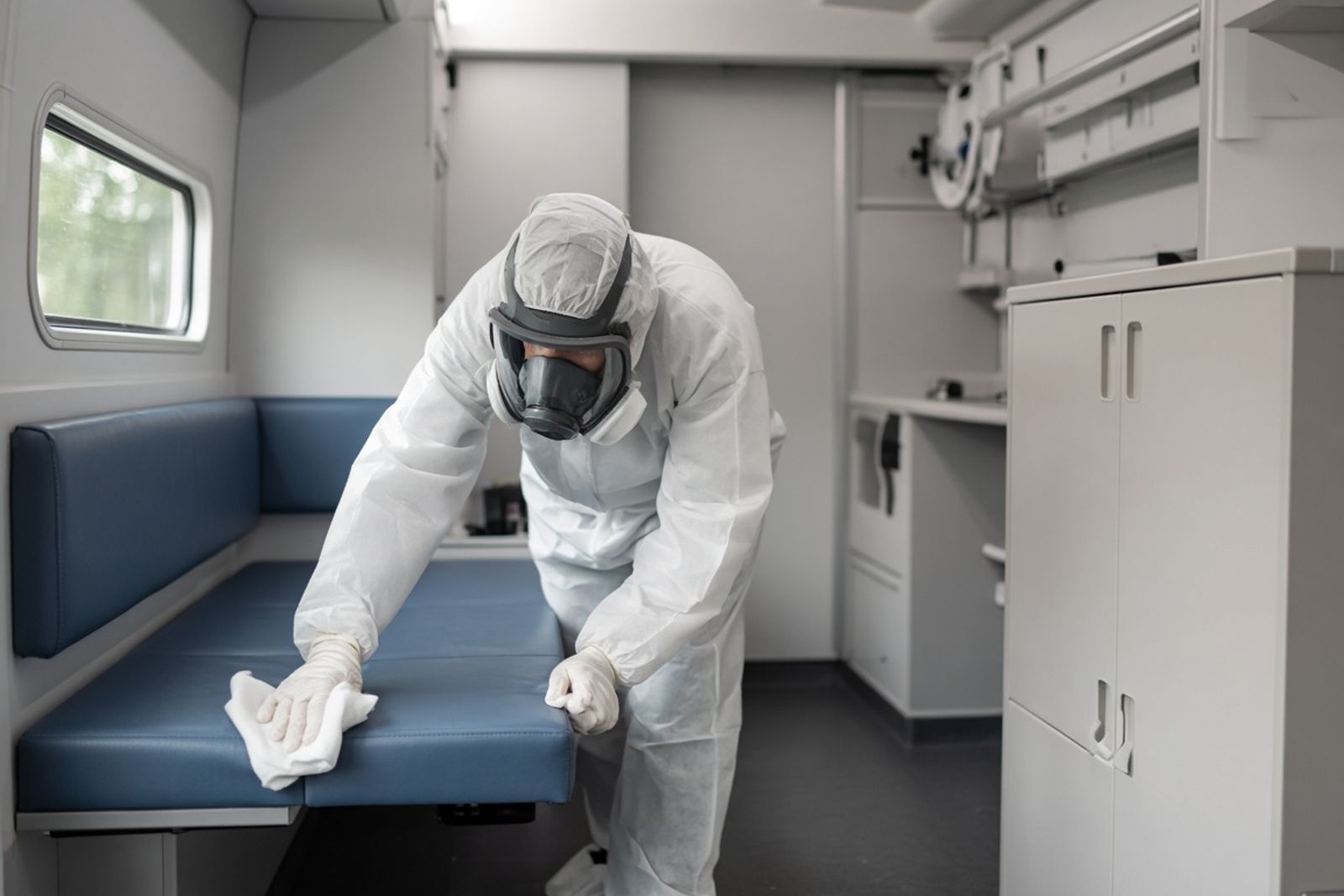
Most people picture emergency vehicle decontamination as a fleet activity: an ambulance backed into a station bay, a crew wiping down the patient compartment, a contractor brought in after a heavy call. That is the commercial side. The vehicle belongs to an agency or company, and the people cleaning it are employees or contractors working under an employer's program.
There is a second, quieter side. Across much of the country, volunteer firefighters and EMTs respond in their own pickups and SUVs. Off-duty paramedics stop at crashes. Police officers take patrol cars home. Responders carry jump bags, turnout gear, and uniforms into their houses and laundry rooms. When those items are contaminated, the cleanup happens in a residential setting, often without the tools or support a station would have.
Both settings deal with the same materials: blood, vomit, other body fluids, and the organisms they may carry. What changes is who is responsible, what resources exist, and who else might be exposed.
How fleet programs handle it
An agency with employees generally has an exposure control plan, approved disinfectants, PPE supplies, a regulated waste contract, and a place to do the work. Crews are trained on how to clean between calls, and supervisors know when a unit needs to come out of service for a deeper clean.
That structure does not guarantee perfect results. Studies of in-service ambulances regularly find contamination on surfaces crews touch. Schaps and colleagues reported in 2026 that 63.1% of service-ready clinicians had at least one targeted pathogen detected, a reminder that people as well as vehicles carry organisms between calls.
Still, the commercial setting has one big advantage: someone owns the problem. If a unit needs a professional decon, there is a budget line, a vendor list, and a supervisor who can authorize it.
Why is the residential side harder to manage?
When a volunteer responder's own truck is contaminated, or a jump bag comes home soaked after a call, there may be no clear owner of the cleanup. The volunteer might assume the department will handle it; the department might assume the volunteer will. Meanwhile the vehicle sits in a driveway and the bag sits in a garage.
Home environments also add exposure paths that stations do not have. Children climb into personal vehicles. Pets sniff gear bags. Family laundry mixes with uniforms. Kitchen sinks become rinse stations. None of these are appropriate places to handle blood-contaminated items.
Finally, household waste systems are not built for regulated medical waste. A trash bag at the curb is not the same as a sealed, labeled container picked up by a licensed hauler. Rules vary by state and county; verify with the local authority what options exist in your area for small quantities of contaminated material.
Side by side: fleet unit vs personal vehicle
It can help to see the differences side by side. The details will vary by agency, state, and the kind of contamination involved.
The goal for residential situations is not to turn a garage into a decon bay. It is to move contaminated items back into a controlled setting, such as the station, as quickly and safely as possible.
- Fleet unit: agency-approved disinfectants matched to vehicle materials; personal vehicle: products chosen by the owner, sometimes household cleaners that may not be registered for the target organisms
- Fleet unit: regulated waste containers and a hauler contract; personal vehicle: household trash unless the department provides a way to return waste
- Fleet unit: trained crews under an employer program; personal vehicle: the owner, often alone and without PPE on hand
- Fleet unit: station bays with appropriate drainage; personal vehicle: driveways and garages where runoff may reach storm drains
- Fleet unit: documented return-to-service; personal vehicle: usually no record at all
An illustrative case: blood in a volunteer's pickup
The following case is illustrative and not drawn from any real district. A volunteer EMT in a rural fire district responds from home in her own pickup. She arrives first at a farm injury and helps control serious bleeding until the ambulance arrives. Afterward, she drives home. Her gloves came off before she got in, but her jacket sleeves, the steering wheel, the driver's seat, and her jump bag all have visible blood.
She parks the truck, leaves the jump bag and jacket in the truck bed rather than bringing them inside, and calls her district's duty officer. The officer confirms she should report the exposure through the district's process and arranges for her to bring the jump bag and jacket to the station, where they are bagged and handled with the district's regulated waste and gear-cleaning procedures.
For the truck interior, the district has an arrangement with a local decontamination company. A technician cleans and disinfects the steering wheel, seat, door handles, gear shift, and floor mat, using products appropriate for automotive vinyl and fabric. The cloth seat has absorbed some blood, so the technician recommends professional extraction and, if needed, replacement of the seat cover.
The district records the event, the cleanup, and the exposure report. It also reviews whether first-arriving volunteers need a small decon kit in their vehicles.
Supporting volunteers and off-duty responders
Departments that rely on personal vehicles can close much of the gap with a little planning. The idea is simple: treat contamination from a response as department business, even when it happens to a privately owned vehicle.
Written guidance matters. A one-page sheet that tells members what to do with contaminated gear, who to call, and where to take it removes guesswork during a stressful moment.
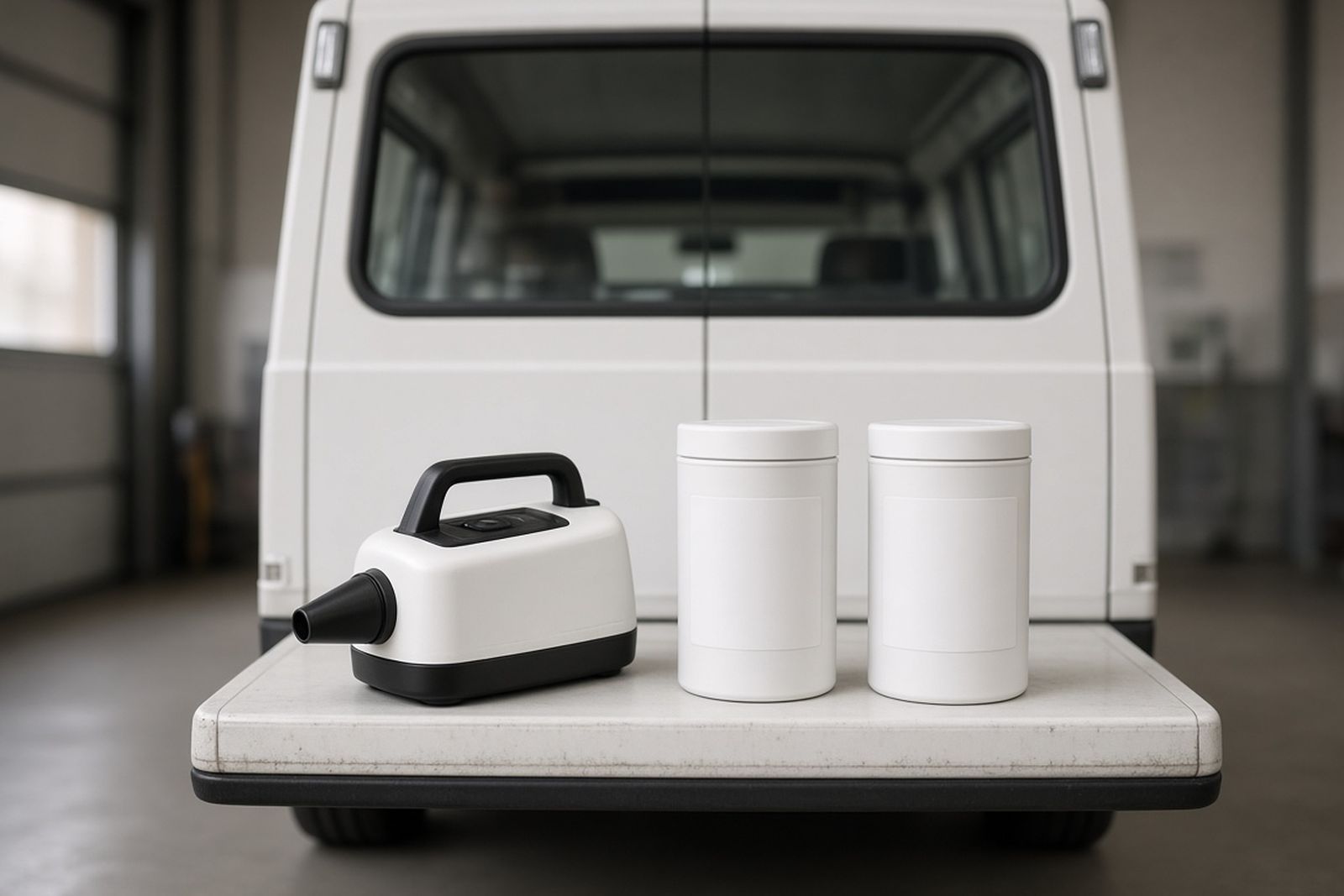
- Issue each responding member a small kit with gloves, a disinfectant wipe canister, a biohazard bag, and a sealable gear bag
- Designate a drop-off point at the station for contaminated gear and uniforms
- Provide station laundering or approved outside laundering for turnout gear and uniforms
- Establish a relationship with a decontamination provider for personal vehicle interiors after response use
- Include personal vehicle contamination in your exposure reporting process
- Clarify in writing how costs for personal vehicle decontamination will be handled
Should contaminated uniforms ever go in a home washing machine?
This is one of the most common questions from responders, and the honest answer is that it depends on your agency's policy and the degree of contamination. Many employers provide laundering for work clothing that becomes contaminated with blood, precisely so that it does not end up in a family washer.
If your agency offers station laundry or an outside service, use it. Bag the item at the scene or in your vehicle, label it if your agency asks you to, and hand it over. That keeps the contamination inside a controlled system and gives your agency a record.
If you are a volunteer and no laundering option exists, raise it with your leadership rather than improvising. A soaked uniform is not an ordinary load of laundry, and running it with children's clothing or kitchen towels is a risk nobody should have to take. For heavily soiled items, disposal and replacement may be the more sensible choice.
Boots deserve a mention too. They collect fluids in treads and seams and then walk through your front door. A boot wash or a designated scrub-and-disinfect spot at the station, used before you drive home, prevents a lot of tracked contamination.
Patrol cars and take-home fleet vehicles
Take-home vehicles sit between the two categories. A police cruiser or a fire officer's command SUV is agency property, but it may spend nights in a residential driveway. If a patrol car's rear seat is contaminated during a transport and the officer drives home at shift end, the contamination has effectively moved into a residential setting.
Agencies with take-home programs should set a clear rule that contaminated vehicles are cleaned or swapped before they go home. That rule protects officers' families and keeps decon work in a place with proper waste handling.
Rear seats in patrol cars are often hard molded plastic for exactly this reason, but seatbelts, door seals, and cage partitions still collect fluids. Those areas deserve attention whether the car goes home or not.
Which approach should you choose when it is your vehicle?
If you are a fleet manager, the commercial path is already open to you: use your program, your products, and your vendors, and make sure your procedures reach take-home and personal vehicles used for response.
If you are a responder facing contamination in your own vehicle or home, contact your agency first. Report any personal exposure promptly through their process. Keep contaminated items out of the house and away from family members. For anything beyond a small, easily cleaned spot on a hard surface, a professional decontamination provider is often the safer choice, particularly for fabric seats and carpets.
Whichever setting you are in, remember that the goal is the same: remove soil, disinfect properly, dispose of waste correctly, and keep the people around you from coming into contact with what you encountered on the call.