Free emergency vehicle decontamination tool
Emergency Vehicle Decontamination First 24 Hours Planner
Tell the planner a few facts about the situation and get an ordered list of who to call, what not to touch, and what to photograph.
The first day after a unit comes back very dirty is a string of small choices. Those choices decide whether the next crew and patient are safe. Someone has to tag the unit out and decide whether coverage lets it stay down. For a police vehicle, someone must check whether it holds evidence that must be kept before cleaning. Someone must tell the infection-control officer and record any crew exposure. And someone must photograph the inside before anything is removed. If a station bay is shared, other crews need to know to stay clear. This planner asks a few facts about your situation. Has the vehicle been released from any evidence hold? Was any crew member exposed? Are there odors or needles? Is the unit contracted or leased? Then it gives an ordered action list for those facts.
The list covers who to notify and in what order. It says what to leave alone until it is recorded, and what to photograph from where. It leans toward caution. When evidence may be present or an exposure needs to be recorded, it tells you to save and record things before cleaning. It does not replace your infection-control plan or your agency's exposure steps. It also cannot know your state's health rules. Those vary, so confirm them with the right agency. Use it as a helper checklist. Save the result so the next shift gets a written plan, not a spoken handoff at the bay door. If your agency has a duty officer, give them the saved list. Let them change who does what as the shift changes.
How to use it
- 1Answer each question about your situation honestly. Include whether an evidence hold applies and whether anyone was exposed.
- 2Read the ordered action list from the top and assign each item to a named person on the current shift.
- 3Follow the photo guidance to record the patient area before you remove mats, linens, or soft items.
- 4Copy or print the list, write down when each step was done, and attach it to the unit's cleaning record.
Prefer to ask a person?
Your request is sent to the follow-up inbox. A coordinator can reply by email. Not for emergencies; call 911 first if anyone is in danger.
Plan the first 24 hours
Emergency Vehicle Decontamination: first 24 hours planner
Answer a few questions and the planner orders the next steps. It does not dispatch help and cannot replace emergency services.
Your ordered plan (6 steps)
- 1
Keep people and pets out of the affected area
Close the door and keep the area sealed until a qualified provider assesses it.
- 2
Photograph from the doorway before anything moves
Take wide shots first, then closer shots of stains, damage and belongings. Do not step into the area to do it. These photos support insurance and estate records.
- 3
Report the loss to your insurer and get a claim number
Ask the adjuster whether they need to inspect before materials are removed, and whether they have a list of approved remediation providers. Coverage depends on the policy and the cause of loss.
- 4
Call a qualified remediation provider for an assessment
Describe what happened, the rooms involved, and any odor, fluids or sharps. Ask which OSHA standards apply to emergency vehicle decontamination and for proof of training and insurance before work starts.
- 5
Start a written log
Record who you spoke to, when, and what they said. Keep receipts for lodging, boarding, locks and any emergency purchases.
- 6
Look after the people involved
If a death or violent event is involved, victim assistance programs, hospice bereavement teams and the 988 Suicide & Crisis Lifeline can help. You do not need to manage this alone.
A worked example
Picture a private patient van company. One of its vans comes back from a dialysis run after the patient had a serious bleed on the way. The crew is shaken. One attendant has blood on a forearm where a glove cuff pulled back. The van is booked for more runs that afternoon. The operations supervisor opens the planner. She notes that no evidence hold applies and that a crew member may have been exposed. She notes that no needles are involved, that there is an odor from the seat area, and that the van is leased. The planner's list starts with the crew member's exposure. Wash, report, and follow the company's after-exposure steps before anything else. Next, it tells her to tag the van out of service and ask dispatch to reassign the afternoon runs. She should tell the infection-control lead and the leasing company, because the seat may need replacing. She should photograph the patient area from the doorway and from each side before removing anything. It tells her to bag the dirty linens at the van, not carry them through the office. She should keep the van closed and parked away from other vehicles. She should wait on odor products until the source is removed. Picking a vendor comes further down the list. She assigns each item and logs the times.
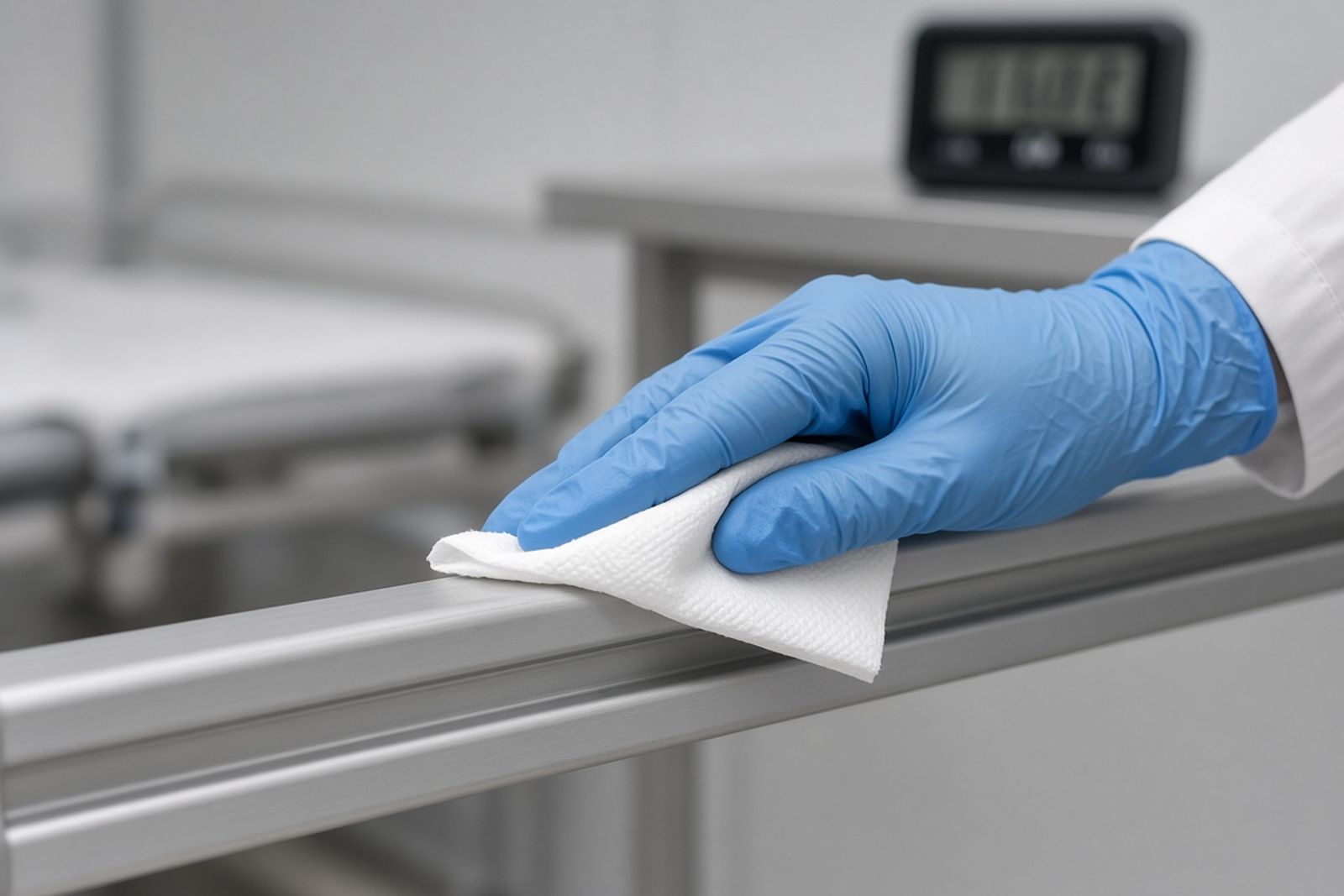
Numbers behind 24-hour planner decisions
- 52%
The reported contamination rate fell from 52% before disinfection to 8% afterwards.
Read with care: Abstract does not provide sample count; product-specific; contamination is not infection.
Source: Farhadloo et al. (2018)Ambulance cabins and equipment in Qom, Iran, treated with one named disinfectant.
- 48
Semi-critical breathing-apparatus samples were culture-positive in 48 of 104 instances.
Read with care: Detection is not infection; small local fleet; most isolates were environmental flora.
Source: Noh et al. (2011)13 Seoul ambulances; 33 sites each, 429 samples.
- 19
An added hydrogen-peroxide wipe protocol left 19 of 48 sites tracer-positive.
Read with care: Surrogate-virus transfer, not measured patient infection; local workflow.
Source: Valdez et al. (2015)EMS field experiment using seeded bacteriophage as a microbial surrogate.
- 9
Emergency 9-1-1 vehicles had more contamination than nonemergency transport vehicles.
Read with care: Detection of selected pathogens is not measured patient transmission.
Source: Schaps et al. (2026)20 ambulances and 27 clinicians from two US agencies; 941 samples, 2021–2022.
These figures are public research and agency data, not this network's own job records. Keep each number with its population, year and limits; none of them predicts cost, timing or outcome at a specific property.
First 24 Hours Planner questions for emergency vehicle decontamination
Why does the planner ask about evidence holds for police cars?
The back seat area may hold evidence from an arrest or from a medical event under investigation. Cleaning before the supervising officer releases the vehicle can destroy that evidence. It can also harm a case. The planner treats a vehicle that has not been released as a full stop. It shifts the list toward saving evidence, notifying people, and keeping records. That lasts until the release is confirmed and written down.
What should I photograph, and how?
Photograph the patient area from the doorway and from each side before anything is moved. Then take close-ups of each dirty surface and soft item. Include what is under the mats once you lift them. Keep the images in a secure folder tied to the unit number. Avoid needless graphic detail. The goal is to show how far the mess spread and to back up replacement choices. It is not to make images that get passed around.
How does the planner handle a crew member exposure?
It puts the exposure response at the top of the list, ahead of any vehicle task. It points you to your agency's after-exposure steps under the bloodborne disease standard. It reminds you to record the exposure and offer a private medical exam. It also reminds you to bag any dirty uniform items. The planner does not give medical advice. It just makes sure this step is not skipped in the rush to deal with the vehicle.
What if coverage requires the unit back in service quickly?
The planner marks coverage as a choice for command staff. It is not a reason to cut the clean short. It suggests telling dispatch early and checking for a spare unit or mutual aid. It also suggests giving a realistic time range based on contact time and what the soft items need. A unit sent back with a wet cushion or a skipped disinfecting step is not truly ready for service.
Does the planner apply to a leased or contracted vehicle?
Yes. When you say the vehicle is leased or belongs to a contractor, the list adds a step to notify the owner or leasing company. This matters most when seats or parts may need replacing. It also reminds you to check the agreement for rules on reporting damage. The safety steps stay the same no matter who owns the vehicle.
Should one person complete the planner, or can it be handed between shifts?
It can be handed off, and on long events it often should be. The key is a clear record of what was done, by whom, and what remains open, so the incoming officer does not repeat or skip steps. Print the current list at shift change, walk through open items together, and have both officers initial the handoff. One named owner at a time keeps accountability clear.
What if the planner's steps conflict with what a hospital asks at the ramp?
Hospitals sometimes have their own rules about cleaning or waste on their grounds. While you are there, follow sensible hospital instructions, such as where to park or which containers to use. Keep your agency's safety steps in place too. If the conflict affects the unit's cleaning or waste, call your supervisor. Write down the issue so your agency can sort it out with the hospital later.
Related community polls
Every count is a real visitor vote; nothing is seeded or padded. One vote per poll per device, and you can change your answer.
After a bloody transport, what usually decides whether your unit gets a full deep clean?
Who performs terminal cleans on your fleet most of the time?
Other emergency vehicle decontamination tools
Cost Range Estimator
Set the affected area, surface types, severity and extras to see an educational cost range and the factors that move it.
OpenProvider Vetting Checklist
Fifteen questions to ask any remediation provider, a readiness score, and a copyable list of what is still unanswered.
OpenInsurance Claim Organizer
A guided checklist from finding the policy to tracking the carrier decision, with a printable summary of where the claim stands.
OpenWaste & Disposal Classifier
Five questions about the material point to the likely waste category and which authority to confirm the rules with.
OpenDIY or Call a Pro? Risk Check
Eight yes-or-no questions that produce a risk level and explain when professional help is the safer choice.
OpenMore on emergency vehicle decontamination
Emergency Vehicle Decontamination services
Learn how deep cleans of ambulances, fire trucks, and police cars are planned. See needle sweeps, choices about soft items, and records by unit number.
Costs explained
What drives the price, published cost ranges, and how to read a written quote line by line.
Insurance and payment
Which policies may respond, how to document a claim, and what to do if coverage is denied.
Community polls
See how other EMS, fire, and police fleets handle time pressure, new soft items, records, and product choices in their own bays.
Knowledge quiz
Test what you know about cabin hazards, who pulls a unit from service, containment, contact time, waste, and cleaning records before the next hard call.
Articles and resources
Articles on fleet infection-control plans and picking products that are safe on electronics and seats. Read about turnaround planning, evidence in patrol cars, and records that pass an audit.