Short answer
OSHA does not have a rule just for cleaning vehicles. But several general rules apply whenever workers clean soiled ambulances, fire trucks or patrol cars. The Bloodborne Pathogens standard drives written plans, training, vaccines and cleaning schedules. Other rules cover protective gear, breathing protection and chemical safety. Public agencies may fall under a state plan instead of federal OSHA. So confirm which regulator covers your fleet.
No vehicle-specific standard, but a clear framework
No single OSHA rule is named for emergency vehicles. Instead, your decontamination (decon) program sits where several general rules meet. These rules apply to any employer whose workers may touch blood, other body fluids that can carry disease, or harmful cleaning chemicals.
That setup surprises some fleet managers. They expect a checklist that says exactly how to clean a cot mount or a cabinet track. Instead, OSHA gives a framework. Find out who is exposed. Write down how you limit that exposure. Train people and give them the right gear. Keep records that show you did it.
The hands-on details belong in your own written steps. These include which surfaces get cleaned after every call and which products crews use. OSHA expects those steps to exist and to be followed. An inspector will usually start by asking to see them.
What does the Bloodborne Pathogens standard require of an EMS or fire employer?
The Bloodborne Pathogens standard, 29 CFR 1910.1030, is the backbone of following the rules for vehicle decon. According to OSHA, employers with exposed workers must keep a written exposure control plan and review it each year. They must offer the hepatitis B shot within ten working days. They must also train workers at least once a year.
For a fleet, the exposure control plan should name the job types that clean units. That usually includes medics, EMTs, firefighters and any fleet or station staff who handle soiled equipment. It should also describe the tools and work habits you use to lower risk. Examples are needle boxes mounted within reach and a set decon area with drains.
The rule also expects a written schedule and method for cleaning work surfaces. In a patient area, that schedule usually separates two kinds of cleaning. One is routine cleaning after each transport. The other is a full deep clean after heavy contamination or at set times.
Last, the rule covers what happens after an exposure. That means a private medical exam, follow-up care and records. Say a decon worker is stuck by a hidden needle under a bench seat. That worker has the right to the same after-exposure care as a medic hurt during patient care.
Neighboring standards that reach the decon bay
Bloodborne germs get most of the attention. But a well-run decon program also has to meet several related rules. Each one deals with a different danger that shows up when crews clean a unit.
Treat these as a set. Say an inspector is looking into a chemical splash in the decon bay. In the same visit, they may ask about chemical safety training, your written review of gear needs and your eyewash setup.
- Personal protective equipment (29 CFR 1910.132): a written review of the dangers of decon tasks, and gear chosen to match it
- Respiratory protection (29 CFR 1910.134): a program with medical checks and fit testing if tasks need respirators
- Hazard communication (29 CFR 1910.1200): safety data sheets, labels on containers you fill yourself and training on every disinfectant in use
- Eye and face protection (29 CFR 1910.133): splash protection when mixing or spraying chemicals
- Recordkeeping (29 CFR 1904): logging injuries and illnesses that must be recorded, including needlesticks that qualify
- The General Duty Clause: a catch-all duty to deal with known dangers that no other rule covers
Does federal OSHA even cover a municipal fire department or county EMS agency?
This is one of the most important questions a public fleet can ask. The answer depends on where you work. Federal OSHA usually does not cover state and local government workers directly.
Some states run their own OSHA-approved state plan. There, public workers are usually covered by that state program. The program must work at least as well as the federal rules, and it may be stricter. Some states have plans that cover only public workers. In other states, public workers may have little or no job safety coverage from any agency. Even so, other state laws may still apply.
Private ambulance companies, hospital EMS services and hired decon companies are usually covered by federal OSHA or the state plan where they work. Volunteer departments can raise their own questions about who counts as a worker.
Rules vary by state and county; verify with the local authority. For coverage questions, your state labor department and your agency's lawyer can tell you which regulator is in charge of your crews.
In some places, no job safety agency has direct power over you. Even there, these rules are still the most widely known measure for protecting workers from blood exposure. Many public agencies adopt them by choice. Insurers, accrediting groups and medical directors often expect to see them in your written program.
Why the rules matter inside a vehicle
The rules can feel abstract until you look at what crews really face. NIOSH's 2017 employer guidance said over 22,000 EMS workers go to emergency rooms yearly for job injuries, and about 6,000 of those visits involve harmful substances like blood.
Germs can also survive routine cleaning, even when nobody ignores the rules. A written cleaning schedule is only as good as the time, products and supervision behind it.
For an infection control officer, the NIOSH exposure numbers support budget requests. They can justify set time for decon, better product choices and regular checks, instead of just trusting how a unit looks.
From standard to daily procedure
Following the rules happens in the daily routine, not in the binder. Crews need steps short enough to follow at the end of a hard call. The steps must also be clear enough that two different people would clean the same unit the same way.
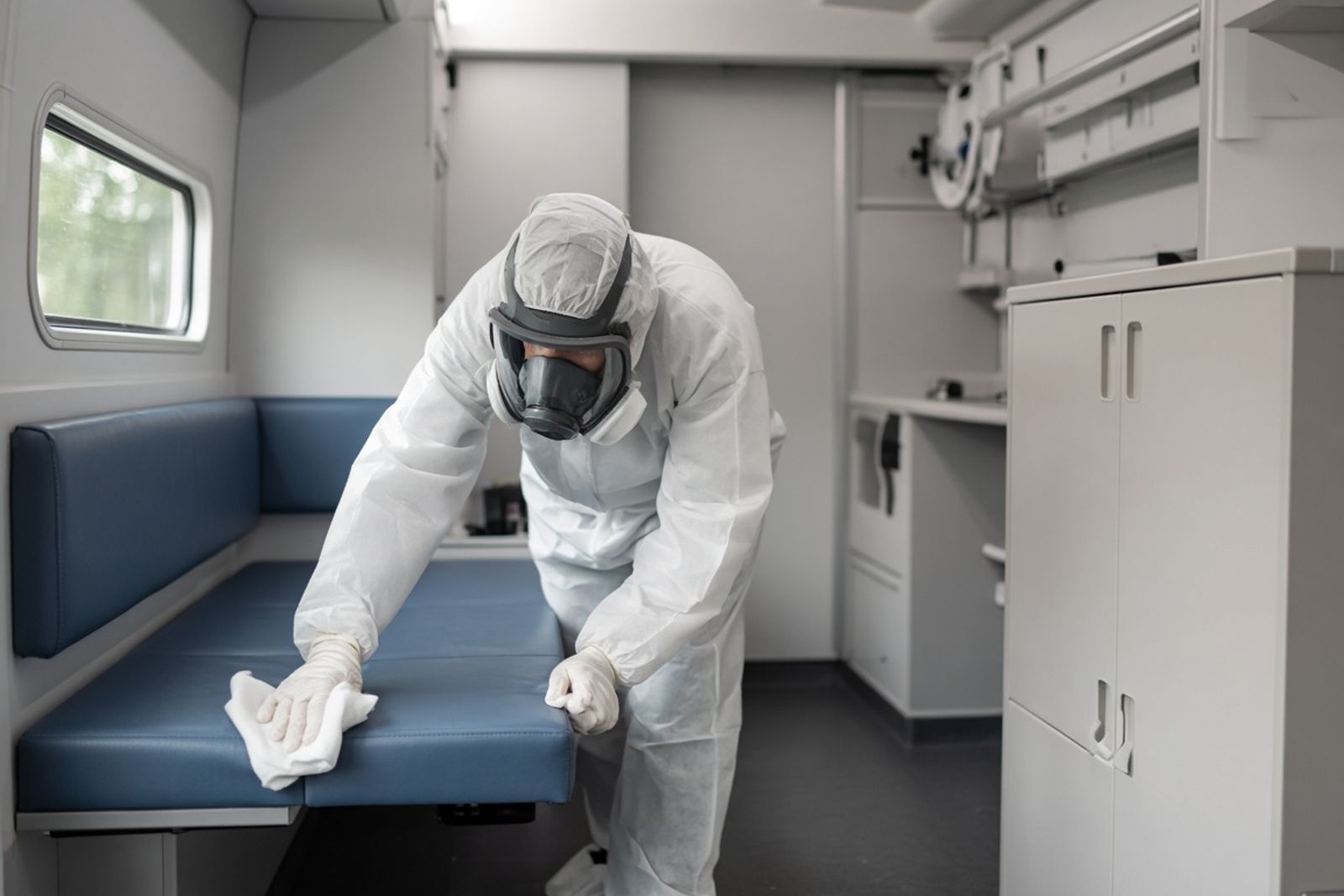
Most agencies use levels of cleaning. A clean between calls focuses on high-touch surfaces and anything that looks dirty. A full deep clean after heavy contamination takes the unit out of service. Crews remove soft items and portable gear. Then they work in order, from the ceiling down and from clean areas toward dirty ones.
Whatever the level, the steps should name the approved disinfectants. They should say surfaces must stay wet for the full time on the label. They should tell crews what gear to wear. They should also explain how to handle needles found during cleaning and where soiled waste goes.
Post the short version where crews can see it. That might be inside a cabinet door in the unit or on the wall of the decon bay. Keep the full version in the exposure control plan.
Build in supervision too. Have a shift officer or a named infection control contact spot-check a few units each week. They can look at wet times, the condition of soft items and whether records are complete. That turns the written steps into a habit instead of a hope.
- Trigger: what event puts a unit into each level of cleaning
- Scope: the surfaces, soft items and gear included at that level
- Products: approved disinfectants and how long the label says they must stay wet
- Protection: required gear and any respirator use
- Needles and waste: how to search, which containers and where the waste goes
- Record: what the crew or worker writes down before putting the unit back in service
Scenario: an inspector's questions after a needlestick
Here is a made-up example. At a private ambulance service, a station worker is doing a full deep clean. A needle is wedged between a bench seat cushion and the wall, and it sticks the worker. The worker reports it right away, and the service follows its after-exposure steps.
Suppose the event leads to an OSHA inquiry. The inspector asks for the exposure control plan. They check whether station workers are listed as an exposed job type. They ask for the worker's training records and hepatitis B shot offer. They also ask for the written cleaning schedule and the needlestick injury log.
The inspector also asks how the service searches for needles before workers reach into hidden spots. The service's steps mention needles only in passing. So the agency revises them. Now workers must search seat seams, floor channels and cabinet tracks by eye and with tools before any hands-on cleaning.
The lesson is not how the inquiry ended, which would depend on the facts. It is that every question led back to a written paper. The gaps in those papers were where the service felt least ready.
Records that show compliance
Records are how you show that your steps are real. They also help your own team spot patterns. For example, one unit may keep needing deep cleans, or crews may avoid a product because it damages vinyl.
Keep training and medical records for as long as the rules require. Store medical records privately and apart from general staff files. Ask your lawyer or risk manager to confirm how long your type of agency must keep records in your state.
Review these records at least as often as your exposure control plan. When steps change, update the training, the posted instructions and the decon record form together. That keeps them in line with each other.
- Exposure control plan with yearly review dates and signatures
- Bloodborne germ training sign-in sheets and summaries of what was taught
- Hepatitis B shot offers, and whether each worker said yes or no
- Signed review of the gear needed for decon tasks
- Safety data sheets for every disinfectant kept on hand
- Decon records for each unit with dates, triggers, products and worker names
- Needlestick injury log and OSHA injury record forms