Short answer
For emergency vehicle decontamination (decon), these are the credentials that count. Look for written training on bloodborne germs and breathing protection. Workers should know your agency's written safety plan. They should know product labels and what equipment makers say about cleaning. Look for the right insurance and any local registration that is required. Just as important is a record for each unit. It shows what was treated, which products were used and whether surfaces stayed wet long enough.
Why training and records carry the weight
An ambulance or patrol car goes back into service quickly. The next crew and patient trust that the vehicle is safe. Nobody climbing into the back of a medic unit can see whether the stretcher mount was cleaned. They cannot see whether the disinfectant stayed wet for the time on its label. Training and records are what make that trust fair.
The stakes run both ways. Poor decon can expose the next patient to germs left behind. It can also expose your own crews every time they open a cabinet or grab a rail.
That is why agencies treat vehicle decon as part of worker safety, not just housekeeping.
What training should in-house crews and outside vendors both have?
Decon may be done by your own staff, a fleet services team or an outside company. Either way, the basic training topics are much the same. The difference is usually depth. A company handling heavy deep cleans should go further than a crew doing a quick wipe between calls.
Ask for records that show each person who does full deep cleans has current training in these areas.
Police and fire fleets deserve the same attention. Patrol car back seats, prisoner partitions and fire truck jump seats can be soiled with blood, spit, vomit or other fluids. Yet the people cleaning them may have had far less infection control training than paramedics. If officers or firefighters clean their own vehicles, their training records should show it.
- Bloodborne germs and the agency's written plan to limit exposure
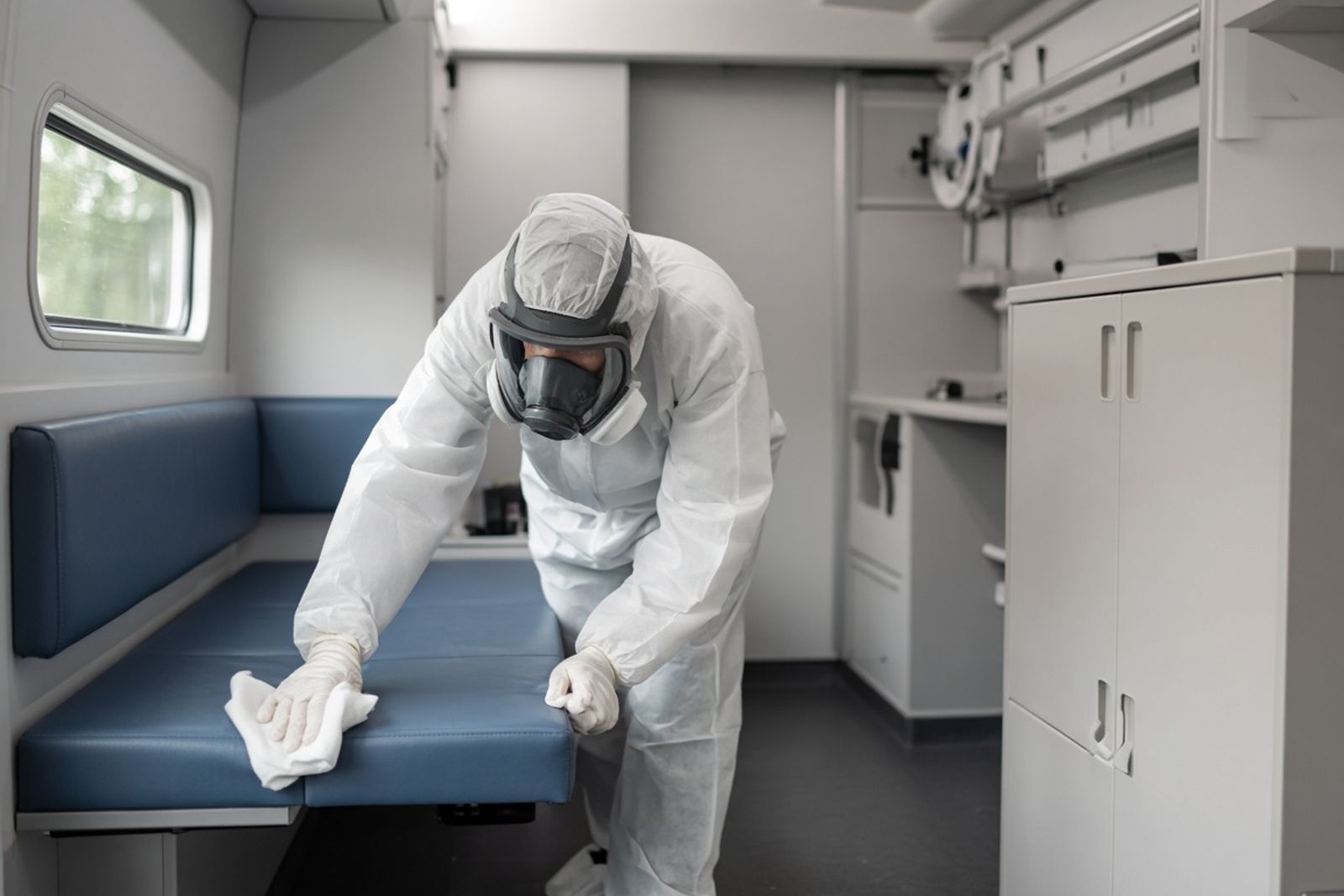
- Breathing protection, including fit testing for any respirator worn during decon
- Putting on and taking off protective gear without soiling the cab or station
- Product labels, mixing, how long surfaces must stay wet and which surfaces are safe
- Equipment makers' cleaning advice for monitors, stretchers and powered loaders
- Checking soft items, including when to wash, replace or take them out of service
- Handling regulated waste from the patient area
Product and equipment knowledge as a credential
Every surface in a patient area has its own needs. A disinfectant that is safe on stainless steel may cloud a monitor screen or crack vinyl seats over time. A worker who does not understand those differences can damage costly equipment. They can also leave surfaces that are harder to clean the next time.
Knowing the label matters just as much. The label sets how to mix the product and how long it must stay wet. It says which surfaces it may be used on and which germs it is proven to kill. A company should be able to explain those details for the products it uses. It should also be able to tell you why it chose them for your fleet. That shows a hands-on credential that no certificate can replace.
Ask whether the company keeps a current list of which products are safe for your devices, and how often it is updated.
Hands-on knowledge also includes the vehicle itself. Workers should know where fluid collects in floor seams and stretcher tracks. They should know which panels can be removed to reach hidden spots. They should also know how to keep liquids away from oxygen outlets and electrical connections. That kind of know-how usually comes from hands-on training with your own vehicles, not a classroom course.
What compliance data says about structured training
Studies show that even crews who mean well do not always disinfect. Take a 2025 review of EMS studies in the journal Antimicrobial Resistance and Infection Control. It found stretchers were disinfected 55% of the time, and stethoscopes only 4.1% to 47% of the time.
Those numbers do not blame individual medics. They reflect the reality of busy shifts, quick turnarounds and competing tasks. They also show why set training, clear checklists and records help. When the steps are defined, practiced and written down, fewer surfaces are missed.
For fleet managers, the lesson is that training should cover the dull items as well as the obvious ones. Stethoscopes, blood pressure cuffs, finger clips for oxygen readings and radio handsets are touched all the time. Yet they are cleaned unevenly.
Do vendor certifications and licenses guarantee quality?
Some companies hold certificates in biohazard cleanup, infection control or vehicle decon. These can be a helpful sign of planned training and ongoing learning. This is most true if the program requires renewal.
They do not promise quality on their own. Ask whose name is on the certificate. Ask whether the workers sent to your fleet hold it, and whether it covers vehicle work. A course on cleaning up crime scenes in homes does not always prepare a worker to work around oxygen systems, powered stretchers and mounted electronics.
Registration and license rules differ a lot. Some areas regulate biohazard cleanup companies or medical waste haulers. Your state EMS office may also have its own rules for vehicle cleanliness. Confirm what applies with your state EMS office and medical director before you sign a contract with a company.
Insurance and contract terms
Companies that work on public safety vehicles should carry general liability and workers' comp coverage. If they move vehicles, they need the right auto coverage too. Some agencies also want coverage for damage to gear in the vehicle. A monitor or powered stretcher can cost a lot to replace.
The contract should list which vehicles and areas are included and whether the cab is covered. It should say how soft items are handled and give target time ranges for returning units. It should explain how the company will tell you if a unit needs more time. It should also require the company to follow your written safety plan and any infection control policies set by your medical director.
It is also worth asking how the company screens and supervises its own workers. Crews may work in secure station bays, around controlled drugs and near patient information left in a unit. Your agency may require background checks, escorts or badges for anyone working inside the station. If so, the contract should say it.
Clear terms protect both sides. They also give your supervisors something solid to point to when a unit comes back unfinished.
What a per-unit decon record includes
Every full deep clean should produce a record tied to one unit. That record helps with spotting trends, follow-up after exposures, audits and accreditation reviews. It also gives crews confidence when they take over a unit that was out of service.
A useful record starts with the unit number and the date and time it left and returned to service. It gives the reason for decon and the areas and surfaces treated. It lists the products and their registration numbers, and the wet times met. It notes soft items removed or replaced and any gear sent to the maker for service. It ends with the names of the worker and supervisor who signed off.
Store records where your infection control officer can review them by unit. A pattern of repeated heavy exposures on one vehicle may point to a design flaw. It may also point to a shortage of soft items or a training need on one shift.
Paper logs work, but many agencies switch to digital forms filled out on a tablet or phone. Whatever format you choose, make the fields required, not optional. That way a record cannot be sent without the product, the wet time and the sign-off.
The value of a good record shows up when something goes wrong. Say a paramedic reports an exposure after learning that a patient carried days earlier had an infection that can spread. The infection control officer needs to know what happened to the unit after that call.
A complete log answers that quickly. It shows when the deep clean happened and whether the stretcher and soft items were removed. It shows whether the patient area and cab were cleaned before disinfecting. It shows whether the product's label covered the germ in question and whether wet times were met. It also shows whether the worker's training was current. With that, follow-up can focus on the crew's direct contact with the patient, and the medical director can see exactly what was done. Without it, every unit that carried the patient becomes a question mark.
Building a credentialed decon program
Start by writing down who does what. Define which cleaning happens between calls and what sets off a full deep clean. Decide whether crews, fleet staff or a company does that deep clean. Tie each role to specific training rules, and keep those training records current.
Next, make the tools the same everywhere. Choose products that match the germs you run into and the gear in your fleet. Post the wet times in the station decon area. Give crews a checklist that includes the items that are easy to miss.
Last, review the records. A monthly look at decon logs, soft item replacement and any exposure reports turns records into a feedback loop. Credentials get you started. But a program that measures its own work is what keeps every unit truly ready for the next call.