Free emergency vehicle decontamination tool
Emergency Vehicle Decontamination DIY or Call a Pro? Risk Check
Eight yes-or-no questions that produce a risk level and explain when professional help is the safer choice.
Every station has done its own cleaning at some point. Sometimes the event is small and on hard surfaces. The crew is trained, has the right products, and has time for full contact times. Then an in-house deep clean can be just fine. Things go wrong when the risk factors pile up. There may be soaked foam a wipe cannot reach, or a possible needle under a seat. Fluid may be in floor channels or vents. The station's disinfectant may damage the electronics. The crew may be worn out or shaken after the call. The vehicle may hold evidence. Coverage pressure may cut the job short. Or there may be no clear way to pack up and haul away what comes out. This risk check walks through eight yes-or-no questions on those points. It gives a risk level and the reasons behind it. Run it again if the crew finds something new partway through, such as fluid in a floor channel.
Here, do-it-yourself means the crew or station staff do the clean instead of a hired vendor. A shortcut can lead to a recorded crew exposure. It can also mean a patient placed on a dirty stretcher, broken equipment, or a cleaning record that fails an audit. The tool leans toward calling a pro when high-risk factors are present. When in-house work makes sense, it lists what that work must still include. That means a needle sweep, full contact time, a check of soft items, the right waste containers, and a written record. Review the result with your infection-control officer before the crew starts. Attach the printed result to the cleaning record so the reasoning is kept.
How to use it
- 1Answer each of the eight questions based on what you can confirm by looking at the unit and talking to the crew.
- 2Read the risk level and the explanation of which factors raised it.
- 3If professional help is recommended, keep the unit tagged out and move to the vetting checklist.
- 4If in-house work makes sense, go over the listed must-haves with your infection-control officer. Record the choice on the cleaning record.
Prefer to ask a person?
Your request is sent to the follow-up inbox. A coordinator can reply by email. Not for emergencies; call 911 first if anyone is in danger.
Check whether DIY is safe
Emergency Vehicle Decontamination: DIY or call a pro?
Eight yes-or-no questions. The result is an educational risk level, not a safety clearance.
1. Is there blood, body fluid, or anything that could carry a bloodborne pathogen?
2. Has the material soaked into carpet, padding, a mattress, drywall or a subfloor?
3. Is there a strong or lingering odor?
4. Could needles, broken glass, drug residue or unknown chemicals be present?
5. Does the affected area cover more than a small spot, or more than one room?
6. Will children, older adults, pregnant people or anyone immunocompromised use the space afterward?
7. Do you need documentation for insurance, a landlord, a sale, or an estate?
8. Would you be doing this while grieving, exhausted or under time pressure?
8 questions left to answer.
A worked example
Picture a volunteer fire department. Its ambulance comes back from a car crash call with blood on the floor, the bench, and the stretcher. The crew says the patient's belongings were scattered all over the patient area. The duty officer wants the crew to clean it, since they have done it before. He runs the risk check. He answers that no evidence hold applies and that the crew has bloodborne disease training. He also says the station has a labeled disinfectant and red bags on hand. But he answers yes to a few other questions. Needles may be present because of the scattered belongings. Fluid reached the bench cushion seam. The crew is tired at the end of a long shift. And he is not sure the station's disinfectant is safe on the monitor. The tool gives a raised risk level. It explains that each of three things pushes the job past a routine in-house clean. These are a needle sweep by tired crew members, a cushion that may be soaked, and doubts about whether the product is safe on the monitor. It notes that the crew's exposure risk goes up when they are tired. It also notes that a soaked cushion cannot be proven clean by wiping. The officer keeps the unit tagged out and gets a spare through mutual aid. He calls a vendor with ambulance experience while the infection-control lead checks the product guidance.
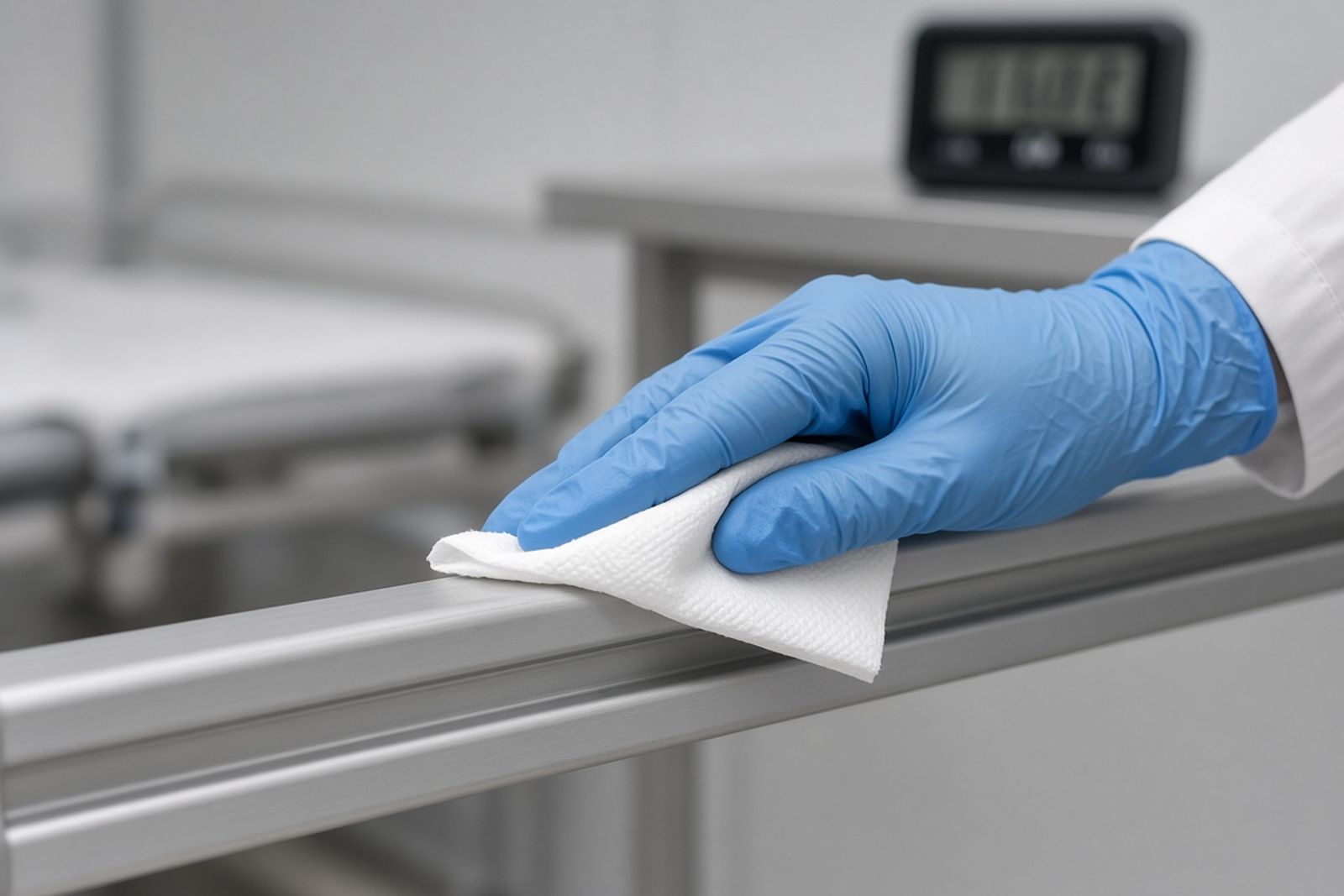
Numbers behind diy risk check decisions
- 60%
60% of ambulances labelled service-ready had at least one targeted pathogen.
Read with care: Detection of selected pathogens is not measured patient transmission.
Source: Schaps et al. (2026)20 ambulances and 27 clinicians from two US agencies; 941 samples, 2021–2022.
- 27
Tracer spread from seeded surfaces to 27 of 48 other sampled sites.
Read with care: Surrogate-virus transfer, not measured patient infection; local workflow.
Source: Valdez et al. (2015)EMS field experiment using seeded bacteriophage as a microbial surrogate.
- 22,000
More than 22,000 EMS workers visit emergency departments each year for work-related injuries, including about 6,000 per year for exposures to harmful substances such as blood.
Read with care: National estimates from a hospital sample with wide confidence intervals.
Source: NIOSH (2017)United States, EMS workers treated in EDs, July 2010-June 2014 (annualized)
- 7.4 per 100 FTE
Ambulance services (NAICS 62191) recorded 7.4 total recordable injury and illness cases per 100 full-time workers in 2023, about three times the private-industry rate of 2.4.
Read with care: Employer-reported; many EMS agencies are public and excluded from private-industry rates.
Source: BLS (2023)United States private ambulance services, 2023
These figures are public research and agency data, not this network's own job records. Keep each number with its population, year and limits; none of them predicts cost, timing or outcome at a specific property.
DIY or Call a Pro? Risk Check questions for emergency vehicle decontamination
Our crews have bloodborne pathogen training. Why might the tool still recommend a vendor?
Training covers exposure awareness and how to protect yourself. It does not cover the full task of a deep clean. That task can include soaked soft items, hidden needles, electronics, and full contact times, all under coverage pressure. The tool weighs those factors along with how tired the crew is and any evidence concerns. When several are present, a vendor with the right products, containers, and time is the safer choice, even for well-trained crews.
What does a low-risk result actually allow?
A low-risk result suggests trained crew members can fairly handle a small event on hard surfaces. They need a labeled disinfectant, the right containers, time for full contact time, and a habit of keeping records. The result does not remove the need for a needle sweep, a check of soft items, or a supervisor sign-off. Review the must-haves the tool lists. Record the choice on the cleaning record.
Does a possible evidence hold change the answer?
Yes, fully. If a supervising officer has not released a police vehicle, no cleaning should happen, no matter what else is true. The tool treats a vehicle that has not been released as a full stop. The same caution applies to any vehicle where the back area might be part of an investigation. Examples include a death in custody or a suspicious injury.
How should a rural station with no vendor nearby handle a very dirty unit?
Keep the unit tagged out, closed, and parked away from other vehicles. Arrange coverage with a spare or through mutual aid. Wait for a qualified vendor, even if that takes time. If the event is truly small and the crew has supplies and rest, the risk check may support in-house work. If so, write down the choice and the reasons. Distance makes things less convenient, but it does not lower the standard.
Can the result help us defend the decision in an audit or grievance?
It can be one part of a recorded choice, along with your infection-control plan and the officer's judgment. Print it, note who reviewed it and when, and attach it to the cleaning record. Auditors and union reps care that a clear, structured choice was made and written down. They do not care which tool produced it. This site does not claim the tool proves you follow the rules.
Should the crew that ran the call answer the risk check questions?
They should take part, since they know where fluids went, what was used, and how they feel. But the officer or supervisor should fill out the check with them. It should not be left entirely to the crew. People coming off a hard call may not see how tired they are or how dirty the unit is. Putting the crew's notes together with a supervisor's judgment gives a more reliable answer.
Should we check again if things change partway through an in-house clean?
Yes. Crews may find fluid under a floor mat, a needle in a seam, or damage they could not see at first. Then the situation may no longer match the answers you gave. Stop and run the check again with the new facts. Switch to a vendor if the result changes. Note the change on the cleaning record. That way, the file shows why the plan changed partway through the job.
Related community polls
Every count is a real visitor vote; nothing is seeded or padded. One vote per poll per device, and you can change your answer.
After a bloody transport, what usually decides whether your unit gets a full deep clean?
Who performs terminal cleans on your fleet most of the time?
Other emergency vehicle decontamination tools
Cost Range Estimator
Set the affected area, surface types, severity and extras to see an educational cost range and the factors that move it.
OpenProvider Vetting Checklist
Fifteen questions to ask any remediation provider, a readiness score, and a copyable list of what is still unanswered.
OpenInsurance Claim Organizer
A guided checklist from finding the policy to tracking the carrier decision, with a printable summary of where the claim stands.
OpenFirst 24 Hours Planner
Tell the planner a few facts about the situation and get an ordered list of who to call, what not to touch, and what to photograph.
OpenWaste & Disposal Classifier
Five questions about the material point to the likely waste category and which authority to confirm the rules with.
OpenMore on emergency vehicle decontamination
Emergency Vehicle Decontamination services
Learn how deep cleans of ambulances, fire trucks, and police cars are planned. See needle sweeps, choices about soft items, and records by unit number.
Costs explained
What drives the price, published cost ranges, and how to read a written quote line by line.
Insurance and payment
Which policies may respond, how to document a claim, and what to do if coverage is denied.
Community polls
See how other EMS, fire, and police fleets handle time pressure, new soft items, records, and product choices in their own bays.
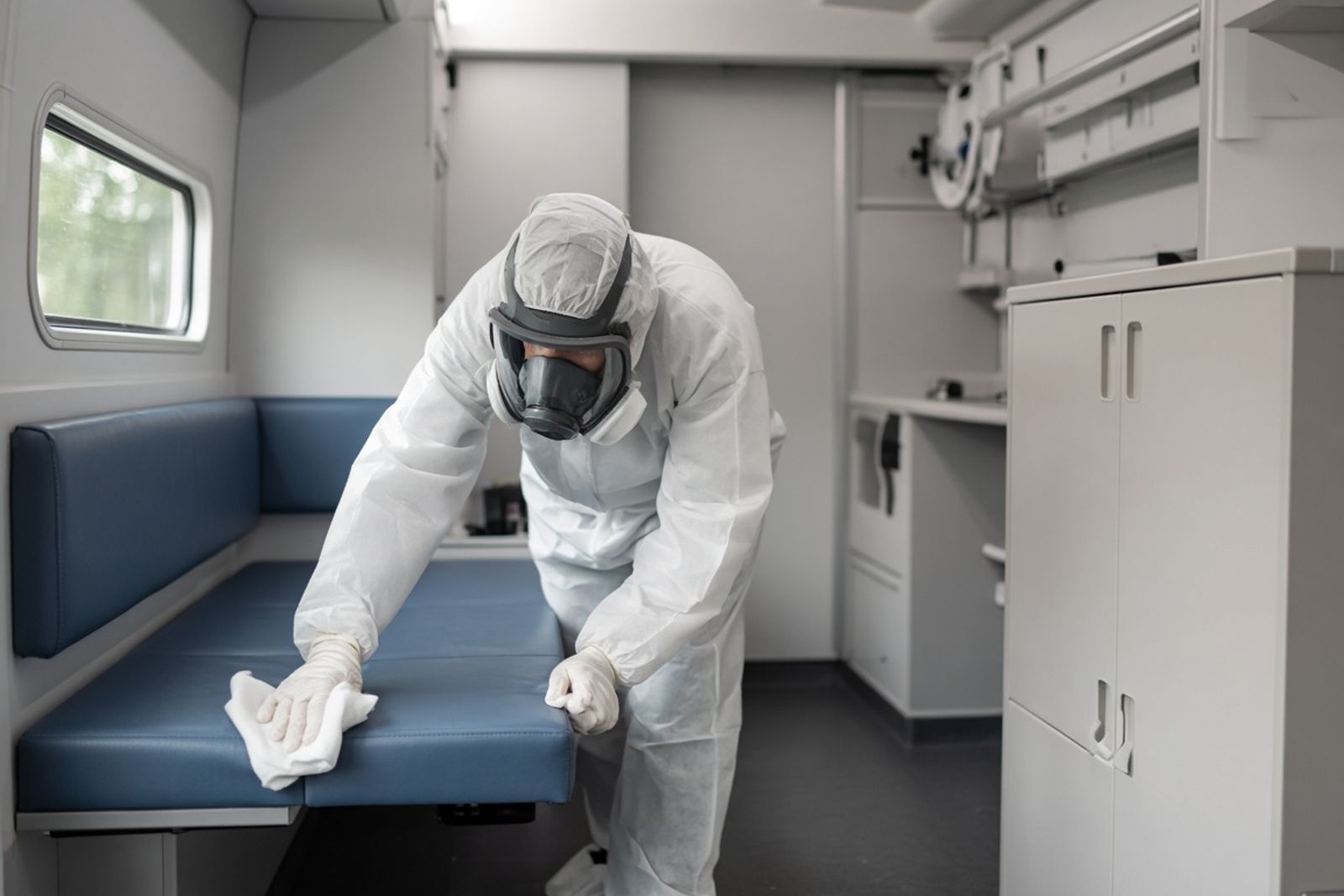
Knowledge quiz
Test what you know about cabin hazards, who pulls a unit from service, containment, contact time, waste, and cleaning records before the next hard call.
Articles and resources
Articles on fleet infection-control plans and picking products that are safe on electronics and seats. Read about turnaround planning, evidence in patrol cars, and records that pass an audit.