Short answer
A defensible emergency vehicle decontamination scope names the triggering event, divides the unit into zones, lists every surface and piece of equipment to be treated, matches products to materials, sets out waste handling, and defines how the unit will be verified and returned to service. The hypothetical below shows how a fleet manager and contractor might build that scope together so it holds up later.
Work order vs defensible scope
A work order says clean medic 12. A defensible scope says what happened, which parts of medic 12 were affected, what was done to each, with what products, by whom, and how the unit was judged ready to return to service. The second version can be reviewed months later by a medical director, an insurer, an auditor, or a crew member with an exposure question.
Scope documents protect everyone involved. The contractor can show it did what it agreed to do. The agency can show it made reasonable decisions with the information it had. Crews can see that the unit they are about to work in was handled carefully.
Everything in the walk-through that follows is invented for teaching purposes. The agency, the call, and the unit are fictional, and nothing here describes a regulatory requirement. The goal is to show a planning process you can adapt.
A good scope also slows people down at the right moment. After a hard call, the instinct is to get the unit back in service as quickly as possible. Pausing for fifteen minutes to write down what happened and what needs to be done usually saves time overall, because the contractor arrives with the right products and nobody has to redo work that was missed.
The illustrative scenario: a heavy-blood transport
The agency in this example is a suburban fire-based EMS service. One of its advanced life support ambulances responds to a motor vehicle crash and transports a patient with serious injuries and significant bleeding. During the transport, the crew manages the airway, starts IV access, and performs a procedure that produces more blood.
At the hospital, the patient is handed off. The crew notices blood on the stretcher, the floor, the action wall, the side bench, a suction canister that tipped, and the rear step. A cardiac monitor cable is visibly soiled. One crew member reports a splash on the forearm above the glove line.
The crew does an initial gross cleanup at the hospital bay, bags linens, secures sharps, and drives the unit back to the station out of service. The battalion's EMS officer decides the unit needs a deep decontamination by the agency's contracted vendor before it returns to the road.
The crew member with the splash is sent through the agency's post-exposure process right away. That step is separate from the vehicle scope, but it is noted in the event record because it shows the event involved real exposure risk.
Intake questions that shaped the scope
Before the contractor arrives, the EMS officer and the vendor's project lead have a short call. The aim is to gather facts, not to guess at a price or timeline.
The answers are recorded in a brief intake note that becomes the first page of the file.
- What was the nature of the call, and was any infectious concern flagged beyond routine bloodborne risk?
- Which areas of the unit had visible contamination, and what gross cleanup has been done?
- Were any doors or compartments open during the call that may have been reached by splash?
- Which pieces of equipment stayed on board and which went into the hospital?
- What materials are the stretcher mattress, bench cushions, and flooring made of, and are any damaged?
- Which disinfectants does the agency currently approve, and are there manufacturer restrictions for the monitor and other electronics?
- Where will the work take place, and does that location have suitable drainage and ventilation?
Dividing the unit into five zones
Zoning keeps the scope specific. It also prevents the common mistake of scrubbing the obvious areas carefully while giving the cab and exterior compartments a hurried wipe.
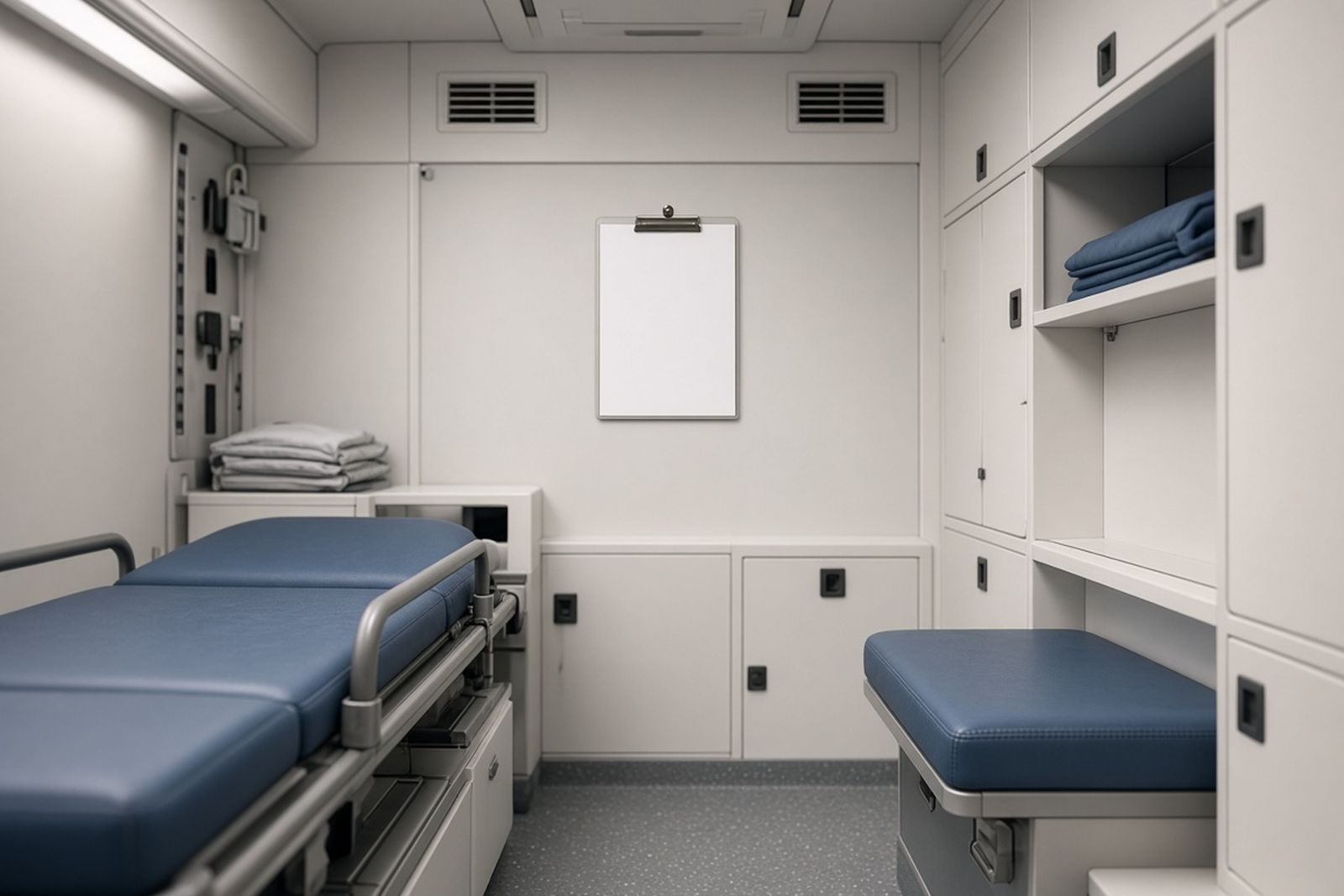
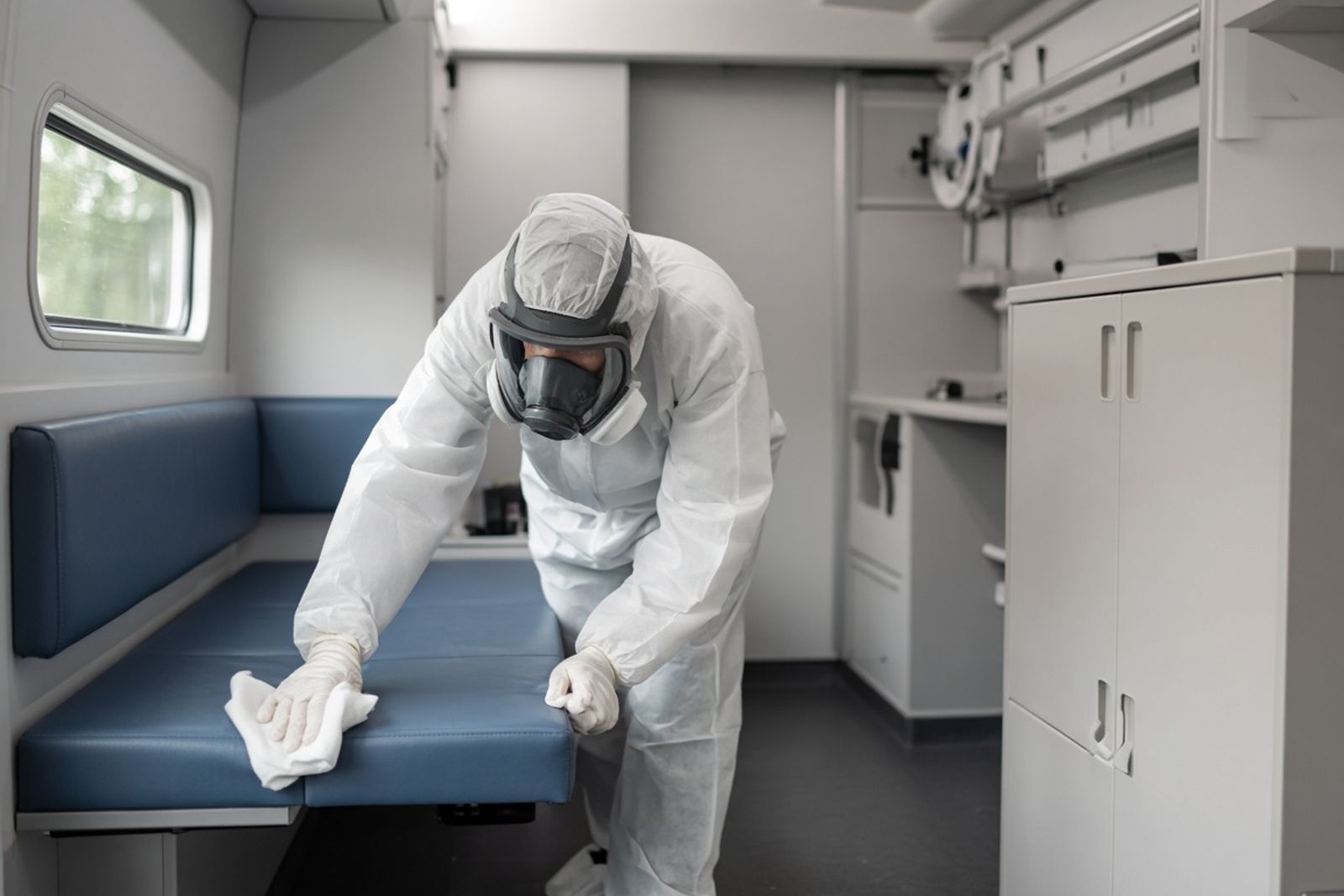
In this example, the project lead proposes five zones. Zone A is the patient compartment floor, stretcher mount, and rear step. Zone B is the action wall, cabinets, and ceiling. Zone C is the side bench, captain's chair, and seatbelts. Zone D is the cab, including steering wheel, radio, mobile data terminal, and door handles, because crew members drove back with gloves off after the call. Zone E is portable equipment: stretcher, monitor and cables, suction unit, and airway bag.
Each zone gets its own line in the scope, with the surfaces listed and the method specified. If Zone D turns out to have no visible contamination, the scope still calls for a high-touch disinfection there, because hands carry material between compartments.
How did product and material choices get documented?
Ambulance interiors contain vinyl, coated fabrics, polycarbonate, aluminum, rubber, and sensitive electronics. A product that works well on a floor may damage a monitor screen or crack a plastic housing over time.
Research on plastics compatibility illustrates the point. In chemical resistance testing reported by Jennings and colleagues in 2024, products above pH 8 accounted for 74% of failures in the experiment. That study was not about ambulances specifically, but it reinforces why the scope should name each product and where it will be used.
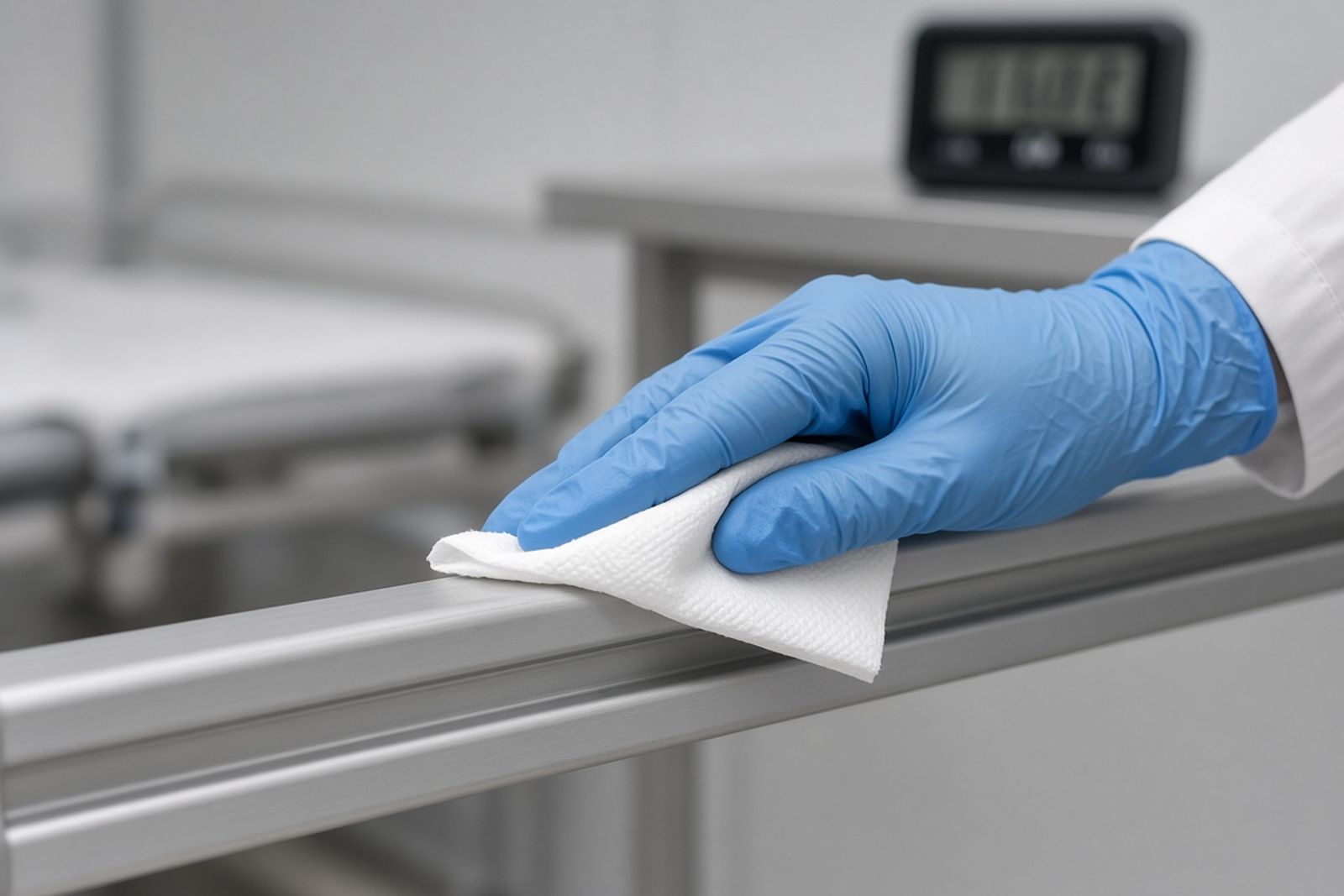
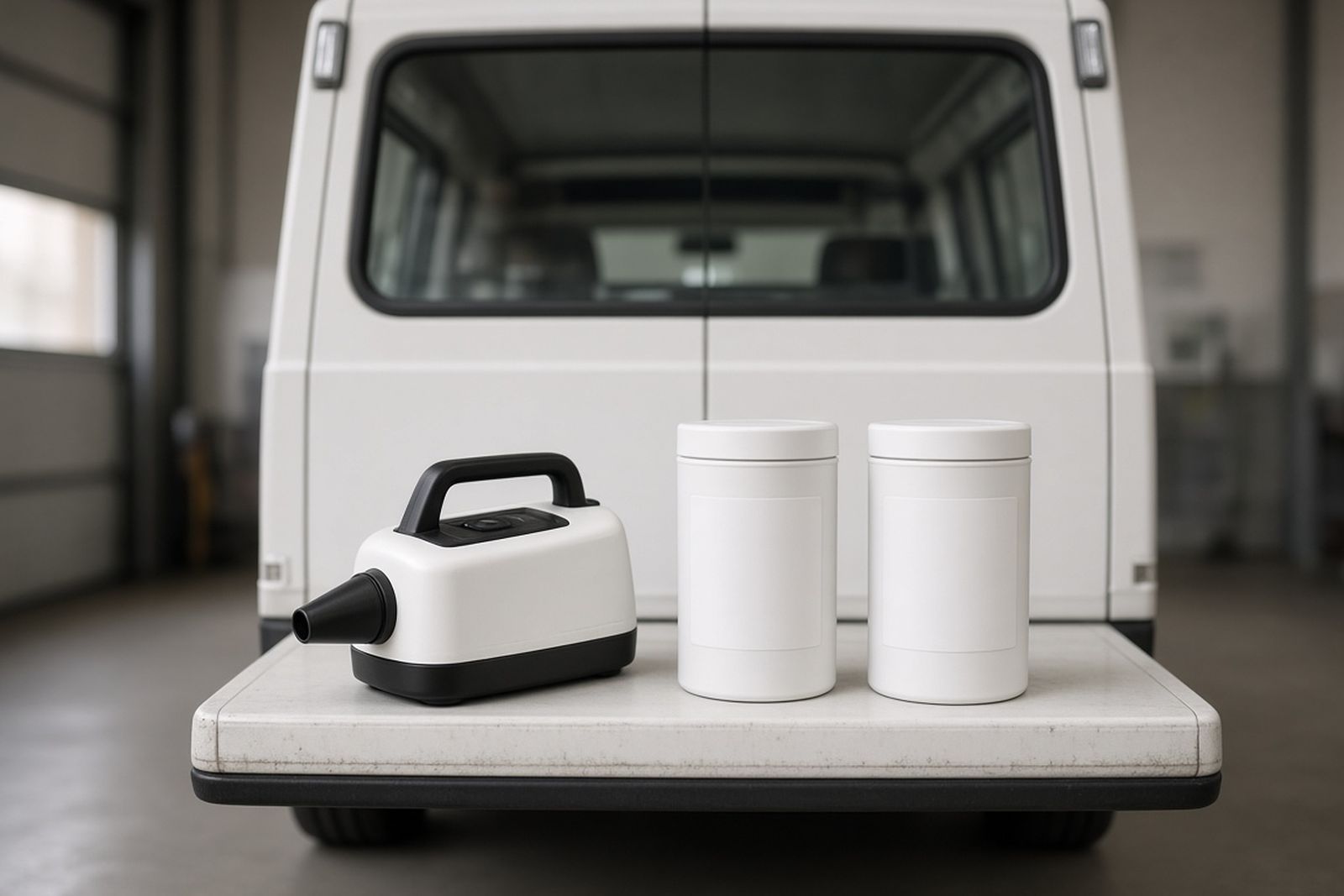
In this hypothetical, the scope lists a detergent for soil removal, the agency's approved registered disinfectant for most hard surfaces, and the monitor manufacturer's approved wipe for the device and cables. The label contact time for each product is written into the scope, along with a note that surfaces must stay visibly wet for that full time.
The stretcher mattress has a torn seam, so fluid may have penetrated the foam. The scope calls for the mattress to be removed and replaced rather than cleaned, and for the replacement to be recorded with its part number.
Waste and water
Waste planning is often an afterthought, and it should not be. The scope in this example states that saturated linens, the damaged mattress, used wipes, and PPE will be packaged as regulated medical waste according to the agency's contract with its waste hauler. Sharps found during cleaning go into a rigid container.
The work takes place in a station bay with a floor drain. The scope notes that the vendor will use a low-water method, relying on wipes and spray-and-wipe application, and that no hose rinse will be used inside the patient compartment. Any rinse water from cleaning removable equipment will be collected and disposed of through a sanitary sewer connection confirmed with station maintenance.
Your state medical waste program, usually housed in the environmental or health agency, sets how regulated medical waste must be packaged, stored, and transported where you operate, so confirm those details before writing them into a scope.
Defining verification before work starts
A scope that does not say how success will be judged invites disagreement later. In this example, the EMS officer and project lead agree on three verification layers before any cleaning begins.
First, a visual inspection of every zone under strong portable lighting, including stretcher mechanisms, seatbelt buckles, and cabinet tracks. Second, a record of each product used, its lot number where available, and the contact time applied in each zone. Third, ATP readings on a fixed list of high-touch points, compared against the agency's internal baseline, with a re-clean if any point exceeds its trigger.
The scope notes plainly that ATP measures organic residue, not pathogens, and that verification supports but does not prove the absence of infectious organisms.
When verification fails
They also agree on what happens if verification fails. A point that exceeds its trigger is re-cleaned and retested, and the retest is recorded next to the original reading rather than replacing it. If the same zone fails twice, the project lead and the officer look together at whether technique, product, or a damaged surface is the cause. Writing this down in advance removes any temptation to quietly re-swab until a number looks acceptable.
What went into the return-to-service record?
When the work is finished and verification is complete, the EMS officer walks the unit with the vendor's lead. Together they confirm that each zone has been addressed, that equipment has been reinstalled correctly, and that nothing was damaged during cleaning.
The closeout file contains the intake note, the zoned scope, photographs before and after, product and contact-time records, ATP results with any retests, waste documentation, the mattress replacement record, and the signatures of both leads. The unit returns to service only after the officer signs.
Why go to this length? Routine cleaning under time pressure tends to miss the same places: seams, latches, buckles, and equipment that nobody thinks of as dirty. A documented, zone-by-zone approach is one way to reduce the chance that a busy crew misses them again.
Lessons to take back to your agency
You do not need an elaborate system to build a strong scope. You need a short intake conversation, a zoned plan, a product list matched to materials, a waste plan, agreed verification steps, and a signed closeout.
Consider creating a template for your fleet, with zones matched to your unit layouts and your approved products pre-filled. When a heavy-contamination call happens, the officer on duty can fill in the facts rather than starting from a blank page.
Review completed scopes periodically. If the same surfaces keep needing a re-clean, or the same equipment keeps getting damaged by the wrong product, the pattern will show up in your files long before it shows up in an infection concern or a costly repair.