Short answer
Expect an intake conversation about the exposure, then a crew who take the unit offline, remove equipment and soft goods, sweep for sharps, clean every surface from top to bottom, and apply a registered disinfectant for its full labeled contact time. Soft goods are cleaned or replaced, equipment is disinfected separately, and the unit is restocked. It ends with a written record and formal return to service.
What will the provider ask before the unit arrives?
A professional decon starts with a short intake. Expect questions about the unit type, what happened on the call or in the incident, whether a specific organism is known or suspected, whether there were sharps involved, and whether the unit was in a collision.
The provider will also want to know what your agency expects to be returned in the unit, what soft goods and equipment you want replaced versus cleaned, and whether any items need to go to your own equipment officer instead. If your agency has a standard decon checklist, send it so the provider can follow your format.
Share only the clinical information needed to choose products and protective equipment. Patient identities are not required, and your privacy officer may have guidance on what can be disclosed.
Tell the provider where the decon will happen. A station bay with drainage, lighting, and ventilation is ideal, while a parking lot may limit which products and methods can be used.
Taking the unit out of service and preparing it
The unit should be formally placed out of service with dispatch before decon begins, so no one assigns it to a call mid-process. The crew that brought it in usually removes personal gear and any items that belong to them.
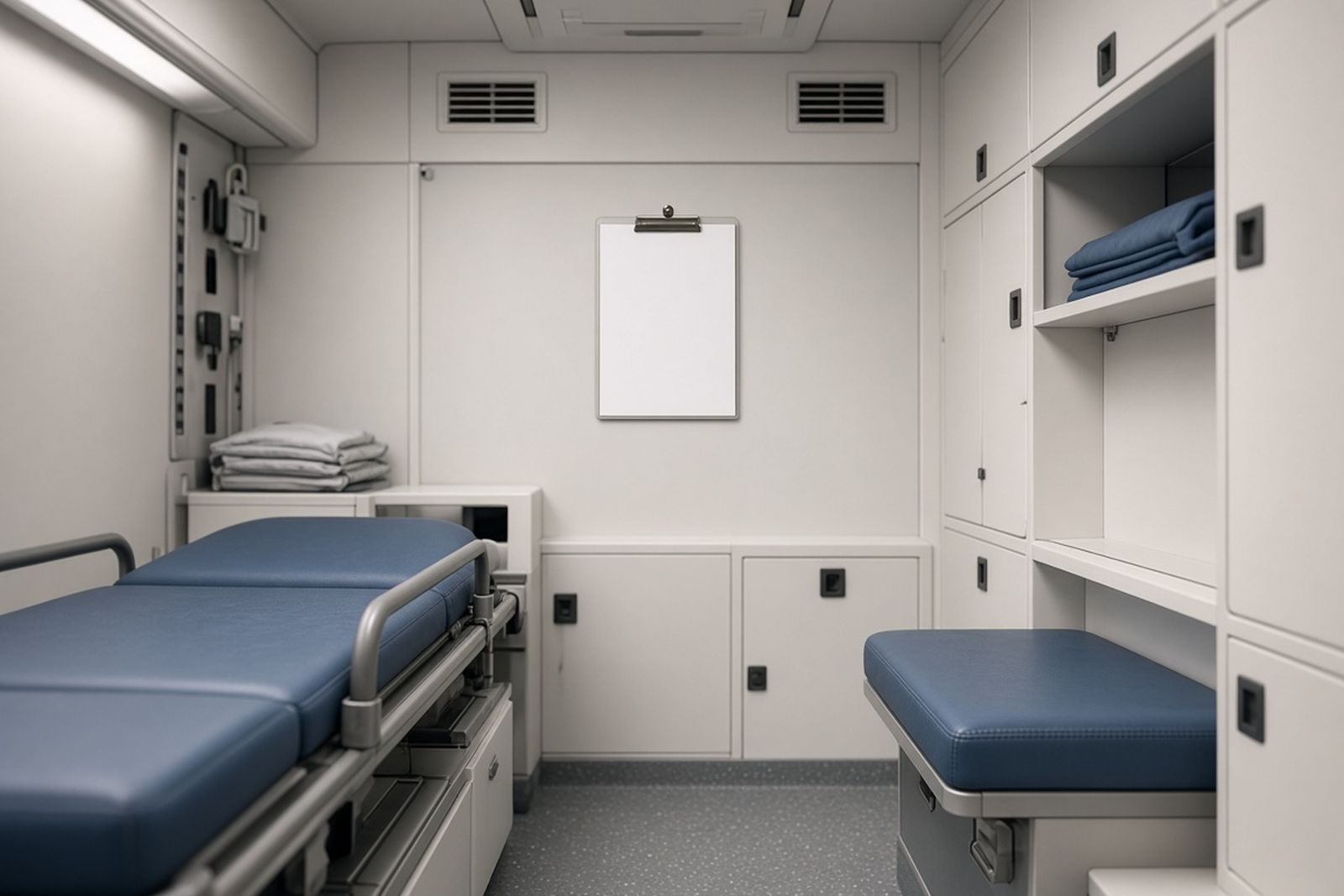
The decon team then empties the compartment. Portable equipment such as monitors, suction units, jump bags, and stair chairs is removed for separate cleaning. Soft goods such as cot mattresses, straps, and linens are pulled and inspected. Supplies that were opened or potentially contaminated are discarded according to your policy.
A careful sharps sweep comes next. Technicians check under the cot, along floor seams, behind seat cushions, inside cabinet tracks, and in door pockets before they put their hands anywhere they cannot see.
Expect the provider to photograph the compartment before anything is moved. Those images help if questions come up later about what was contaminated or which items were discarded.
Cleaning order: top to bottom, clean to dirty
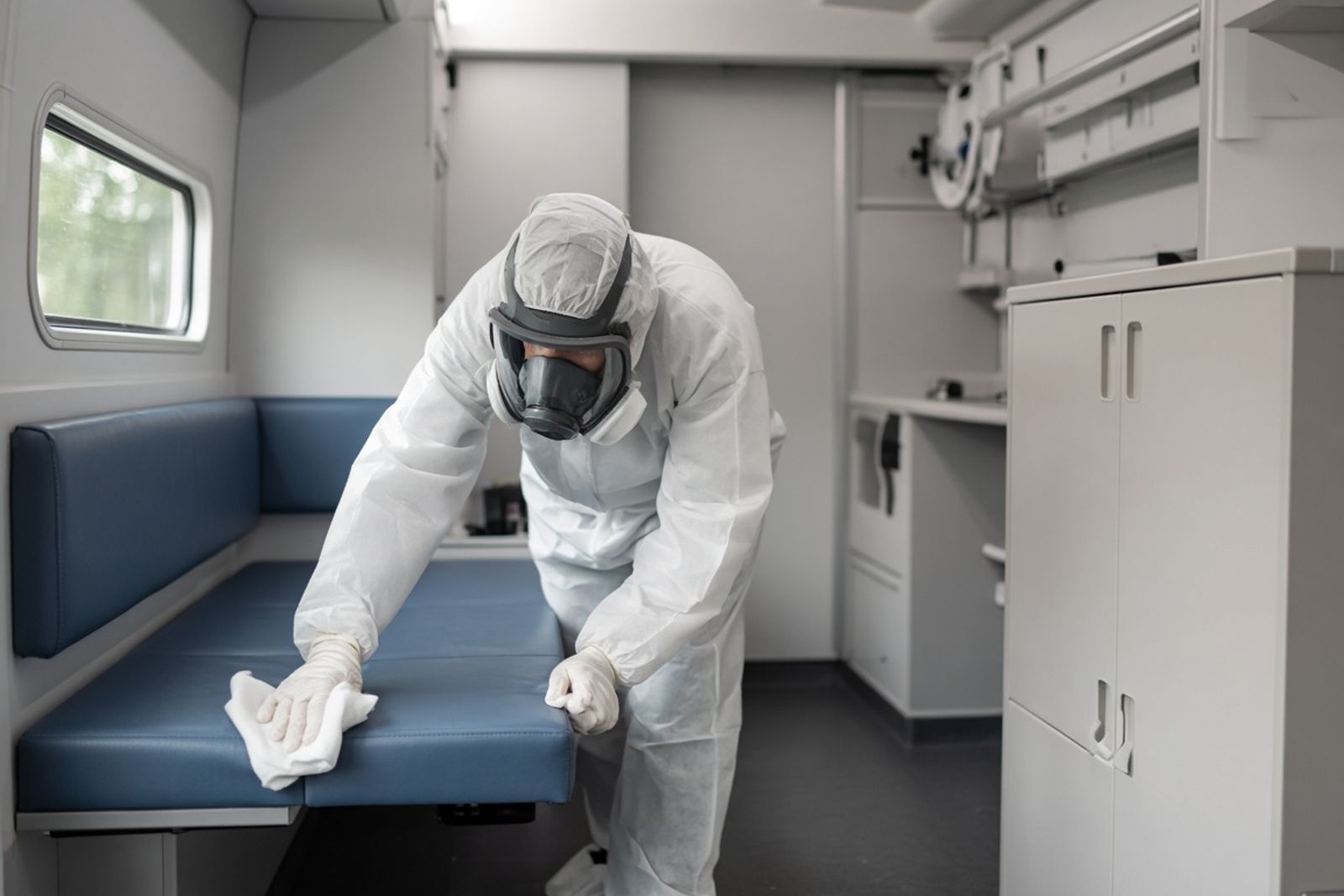
Crews generally work from top to bottom and from cleaner areas to dirtier ones, so contamination does not drip or get dragged back onto finished surfaces. Gross soil is removed first, since disinfectants work poorly on surfaces still covered with organic material.
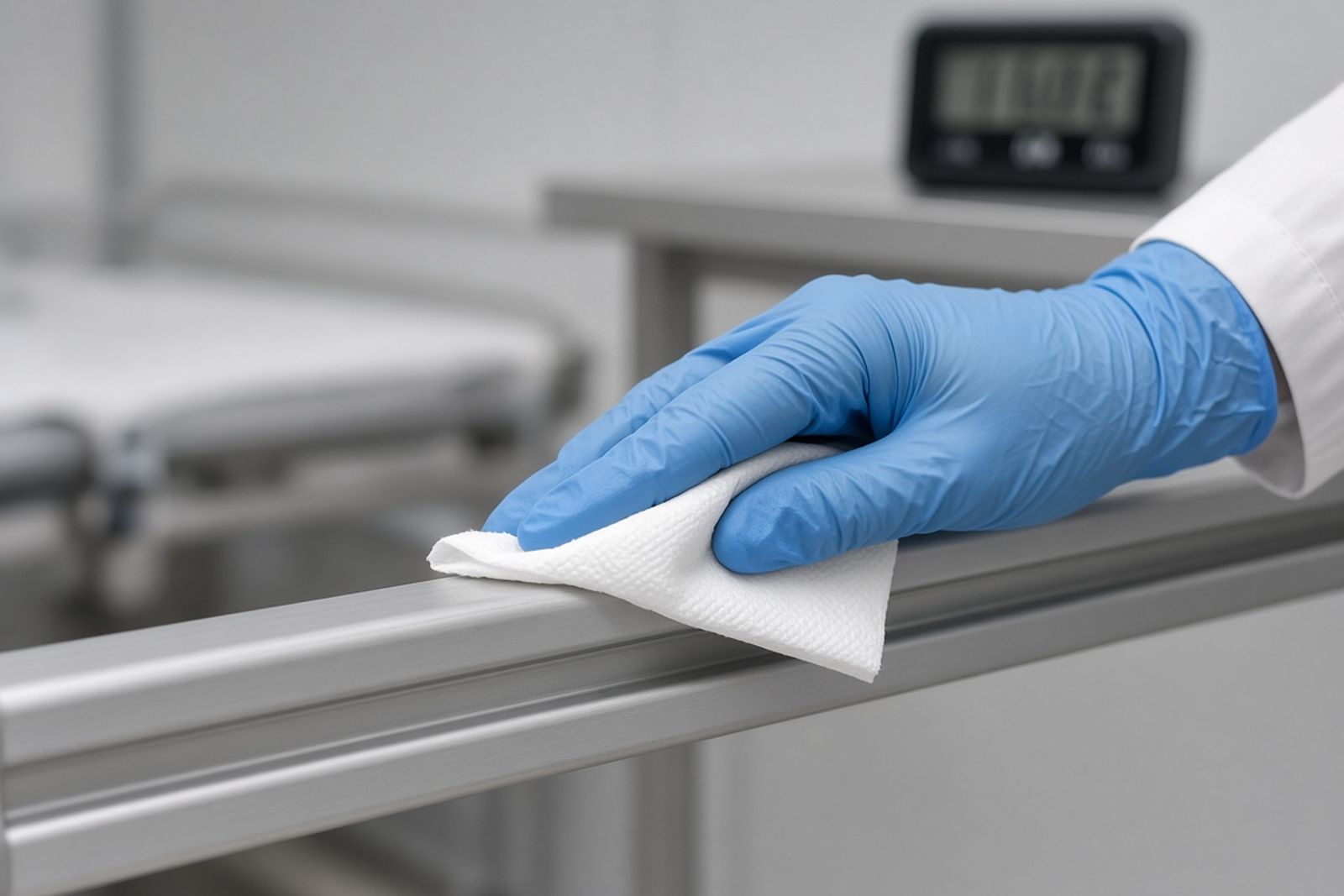
Every hard surface is then cleaned, rinsed if the product requires it, and treated with a registered disinfectant. The surface must stay visibly wet for the full contact time on the label, which may mean reapplying on vertical walls and ceilings.
- Ceiling, light covers, grab rails, and IV hooks
- Upper cabinets, doors, and handles
- Walls, countertops, and the action area
- Seats, seat belts, and headrests
- Cot mount, antler, and floor fastening points
- Floor, floor seams, and the step well
- Cab controls, radio, and steering wheel if the crew worked in the cab after patient contact
Why is contact time such a sticking point?
In a busy system, the pressure to get a unit back on the road is constant, and contact time is the step most often shortened.
Contamination travels further than crews expect, and a quick wipe leaves much of it behind. A professional decon spends its time on thoroughness: reaching every touched surface and giving the product the time it needs.
If your turnaround target cannot accommodate the label's contact time, the answer is a different product, a spare unit, or a revised target, never a shortened dwell.
Soft goods and equipment
Each soft good gets a decision: clean, launder, or replace. A cot mattress with an intact, fluid-resistant cover may be cleaned and disinfected like any hard surface. One with a torn cover or fluid that has penetrated the seams usually needs replacement, because there is no reliable way to disinfect the foam underneath.
Portable equipment is cleaned according to its manufacturer's instructions, with particular attention to handles, cables, and buttons. Items like blood pressure cuffs and reusable straps are often overlooked in routine cleaning and deserve deliberate attention during a terminal decon.
Your agency should specify in advance what the provider may discard and replace on its own and what needs approval. That avoids surprises on the invoice and delays in returning the unit.
Oxygen cylinders, cylinder bags, and airway kits that travel between units or sit in station storage are easy to forget. Ask the provider to include them, or make sure your own staff clean them on the same day, so a freshly decontaminated compartment is not restocked with items that were never cleaned.
Patrol cars and fire apparatus
Although ambulances get most of the attention, patrol cars and fire apparatus also see contamination. A patrol car's rear compartment after transporting someone who was bleeding, vomiting, or incontinent needs attention to the seat, the partition, the floor, and door handles. Hard plastic rear seats are easier to clean than cloth, but seams and seat belt receivers still collect residue.
Fire apparatus cabs can be contaminated by crews returning in soiled gear after extrications, medical calls, or fire scenes. SCBA seats, grab handles, and floor areas are the usual focus. Gear itself should go through your agency's gear-cleaning process rather than being cleaned inside the cab.
The same principles apply: remove gross soil, clean, disinfect for the labeled contact time, and document.
A post-transport decon, step by step
Consider a typical sequence, sketched here for illustration. An ambulance crew has just transported a patient with heavy bleeding from a long rural call. The cot, floor, bench seat, and one cabinet door are visibly contaminated, and the crew is not sure whether a used needle rolled under the cot during the ride.
The supervisor places the unit out of service and requests a terminal decon from the agency's contracted provider. The provider's technician suits up, removes portable equipment for separate cleaning, and performs a sharps sweep, finding a capped syringe in a floor seam. The cot mattress cover is intact and cleaned; the bench seat cushion has a split seam and is replaced from stock.
The technician cleans and disinfects every surface from ceiling to floor, keeping each area wet for the labeled contact time. After restocking, the supervisor and technician walk the unit together and sign the decon record, which lists products, contact times, replaced items, and the sharps found. The unit returns to service with the record attached to its file.
What the decon record includes
A decon record is your proof that the unit was handled properly. It supports your infection control program, your audits, and any questions from crew members or patients later.
Store records where your infection control officer and fleet manager can both find them. Ask your medical director whether your EMS license or local ordinances set specific record requirements.
- Unit number, date, and the time taken out of and returned to service
- The triggering event or reason for decon
- Products used, EPA registration numbers, and contact times
- Soft goods and equipment cleaned, laundered, or replaced
- Sharps or unusual items found
- Name of the technician and the supervisor who approved return to service
Returning the unit to service
Return to service should be a deliberate step, not an assumption. After restocking, a supervisor or designated crew member should inspect the compartment, confirm that equipment is back and functioning, and sign the record.
Only then should dispatch be notified that the unit is available. That brief final check protects the next crew and the next patient.
After handback: repairs and crew feedback
If anything was found during decon that points to a broader issue, such as a damaged cabinet seal, a cot mount that traps fluid, or a recurring stain in the same floor seam, the provider should note it in the record. Pass those notes to your fleet manager. Small repairs made promptly can prevent the same contamination problem from reappearing in the next terminal clean.
Finally, close the loop with the crew who brought the unit in. Letting them know it was cleaned, what was replaced, and whether a sharp was found reinforces good habits and reassures them that exposures are taken seriously.